
Real vs. Fake Christmas Tree: A Full Cost & Headache Comparison Before You Buy

I switched from real to fake after 25 years. See my full cost vs. headache analysis to find out which Christmas tree is right for you!
Hi, I’m Stacy Ling, and as a trained Master Gardener, you’d think I’d be firmly committed to the real Christmas tree camp. And for almost 25 years, I was. We followed the tradition, enduring the endless needle drop, the sticky sap, the constant watering, and the high-stakes family trip to pick out the perfect tree.
We even had a final, frustrating purchase because we spent HOURS in the field searching for the perfect one and couldn’t agree. After much disagreement, we went with whatever, and our last real Christmas tree had a huge bald spot that dropped all its needles right around Christmas Day. It was a massive, sticky mess that convinced me: enough is enough!
Moving from a real tree to an artificial one seven years ago was genuinely life-changing for my family. We can decorate weeks earlier, keep the Christmas magic up longer, and I don’t miss the maintenance headaches at all.
But here’s the truth I learned: If you go faux, you must go good. A high-quality artificial tree is an investment you will have forever because it looks authentic, lasts, and eliminates the urge to toss it out.
If you’re on the fence this year, struggling to choose between tradition and sanity, you’ve come to the right place. We’re breaking down the great holiday debate with a full Cost & Headache Comparison Before You Buy to help you decide which tree truly deserves a spot in your home.
(Posts on stacyling.com may contain affiliate links. Click HERE for full disclosure.)
The Ultimate Cost Comparison: When Does a Faux Tree Pay Off?
Let’s talk dollars and cents. The financial argument is usually what tips people toward a reusable tree. When you compare the upfront cost of a fake tree to the lifetime cost of buying a real one every year, the savings become really obvious.
Annual Expense vs. Long-Term Investment: The 10-Year Tally
| Factor | Real Christmas Tree | Quality Artificial Tree |
| Initial Cost | $80 – $110 (for an average 7-footer) | $450 – $600 (Target Price for a good one) |
| Annual Recurring Cost | $80 – $110 every year | $0 |
| Hidden Costs | Tree stand, disposal fees, gas/time for annual shopping. | Dedicated storage space, or a storage bag. |
| Break-Even Point | Never | Year 3 to Year 5 |
| 10-Year Total Cost | $800 – $1,100+ | $450 – $650 |
As you can see, even if you splurge on a premium, hyper-realistic fake tree, it will be the financially superior choice by your fifth Christmas. At that point, you’re just saving money every year going forward.
The Break-Even Point: Pinpointing the Financial Tipping Point
The data clearly shows that the “cheap” option is only cheap for one season. Since a quality artificial tree is designed to last at least a decade, it is the much smarter choice for your budget long-term. Plus, you’re buying back the time you would have spent shopping every year, and that peace of mind is priceless during the holidays.
The Real Headaches: Maintenance, Mess, and Why I Switched After 25 Years
For me, the decision wasn’t just about money but rather, it was about getting rid of the stress. As a gardener, I don’t mind a little mess, but a holiday mess is a bit different. This is where the artificial tree truly offers a life-changing benefit.
The Daily Stress of Watering and Fire Safety
The absolute worst part of a real tree is the maintenance. You have to monitor that stand constantly. You leave town for a weekend, and you come back to a tree that has guzzled its entire reservoir and is now a brittle fire hazard.
- Real Tree Nightmare: The daily chore of watering, the frantic worry if you forget, and the fact that a dry tree is a significant fire hazard.
- Faux Tree Freedom: Zero maintenance. You set it up, you decorate, and you’re done. The materials are usually flame-retardant, giving you peace of mind and allowing you to decorate earlier in the season. And today’s faux Christmas tree is much easier to put together than one from thirty years ago where you needed to go branch by branch. Nope! Today’s faux Christmas trees are up in less than 5 minutes.
Beyond Needles: Allergies, Pests, and the Dreaded Cleanup
My family was done with the inevitable, infuriating needle drop. It wasn’t just the mess, it was the stickiness of the sap, and the fact that an organic item brought into a warm house is going to decompose, drop its needles, and cause trouble.
- Real Tree Pain: Constant sticky sap and perpetual sweeping. Real trees can also bring mold, pollen, and even small bugs into your clean house.
- Faux Tree Freedom: Minimal mess. The branches are sturdy for heavy ornaments. And the takedown? You just break it down into sections and put it in a bag—no wrestling a stiff, dry tree through the front door.
The pic below shows our very last fresh Christmas tree. If you look closely, you can see how misshapen it is as well as the holes. I don’t know what we were thinking with this tree, but once all the needles dropped, that was it.

The Eco-Friendly Showdown: Is Real or Faux Better for the Planet?
As an experienced gardener, I know the value of growing, and this is where the debate gets surprisingly complicated. Most people assume the reusable option is automatically “greener,” but the full life-cycle assessment tells a more nuanced story.
The Carbon Cost: The Magic Number for Faux Tree Reuse
- Artificial Tree Footprint: The initial carbon footprint of an artificial tree is massive (up to 10x higher than a real tree). This is because it’s made from non-renewable, petroleum-based plastic (PVC and PE) and is usually shipped thousands of miles from overseas factories.
- The Break-Even Point: To offset that huge initial impact, you need to reuse your artificial tree for at least 10 to 12 years. If you swap it out sooner, you are doing more environmental harm than buying a real one every year.
- My Take: This is exactly why investing in a high-quality faux Christmas tree is the environmentally responsible choice. Because you are committed to keeping it for 15+ years.
- Real Tree Footprint: A real tree’s footprint is primarily from the transportation and cultivation (pesticides, water, gas for equipment).
End-of-Life: The Biodegradable vs. Landfill Dilemma
- Artificial Trees are Forever: Faux trees are made from plastic and metal, meaning they are non-recyclable and non-biodegradable. When you eventually dispose of them, they sit in a landfill indefinitely.
- Real Trees are a Crop: Real trees are grown on farms, absorb CO2 while growing, and for every one cut, 1-3 new seedlings are planted. They also provide habitat for wildlife during their growing years.
- Disposal is Key: Real trees are biodegradable. If you compost them, chip them for mulch, or put them through a municipal recycling program, the impact is minimal. The worst-case scenario is tossing them into a landfill, where they decompose without oxygen and release methane (a powerful greenhouse gas).
The Hidden Health Headache: Off-Gassing and Toxins
When we talk about what artificial trees are made of, we can’t ignore the hidden issue of off-gassing. This is the chemical odor or rather, that “new plastic” smell that your tree can release into your home’s air.
- The Main Culprit is PVC: Most lower-cost artificial trees are made with PVC (Polyvinyl Chloride) plastic. PVC is often stabilized with lead (in older or cheaper models) and softened with phthalates. These chemicals can gradually “off-gas” from the tree, settling in your house dust and air.
- The PE Advantage: This is yet another reason to invest in a higher-quality tree. Trees that rely heavily on the safer PE (Polyethylene) plastic for their realistic tips are less likely to contain these toxic additives and typically off-gas less than their cheaper PVC counterparts.
- A Simple Solution: If you do notice a strong plastic smell when setting up your tree, that’s a sign of off-gassing. Just like with new furniture, the best thing to do is air it out. If you have a garage or covered patio, let your tree sit out there for a few days before bringing it into your main living space.
The Aesthetic Debate: Character vs. Perfection
Beyond the cost and the mess, there’s the look of the tree—and this is a tough one, because it’s deeply personal.
Why We Miss—and Don’t Miss—the Real Tree’s Look
A real tree is pure character. It has that one weird gap, a slightly crooked top, or a thin spot in the back. That’s part of the charm! You get the incredible, genuine pine smell and no two are ever the same.
The flip side? That weird gap can be huge, and that crooked top makes fitting a topper impossible. We’ve all spent an hour rotating a real tree just to hide the bald spot!
The Faux Tree Advantage: Authentic Realism and Perfect Symmetry
Modern, quality artificial trees—the ones in that $450–$650 range—have closed the aesthetic gap almost entirely. Here’s why many people prefer the look of a good faux tree:
- Uniform Perfection: They offer flawless, uniform sizing and shape year after year. Every side is full, and the branches are perfectly distributed.
- Engineered Realism: The high-end trees that use PE needles don’t look like flat plastic. They have depth, color variation, and a realistic branch structure that truly fools the eye.
- Optimal Decorating: The sturdy branches are engineered to hold heavy ornaments without drooping, and they have just the right amount of space between branches to let the lights shine and ornaments hang beautifully.

Expert Guide: How to Choose a Realistic Faux Tree That Lasts a Lifetime
I told you that you must “go good” if you go faux. If you’re trying to replicate the authentic look and feel of a real tree without the hassle, you need to know what to look for when you’re ready to spend $450 to $650 on that long-term investment.
The $600 Difference: Why Quality Faux Trees Are Worth the Investment
The difference between a cheap $200 tree and a quality one is simple: realism. A great tree is an heirloom that will look full, look like it was harvested from nature, and authentic for 10-20 years. A cheap one will look sparse and plastic, the color will be off, and you’ll want to replace it within a few years.
PE vs. PVC: The Single Most Important Factor for Realism
You need to pay attention to the materials used to make the needles. This is the secret to realism:
| Needle Type | Material and Appearance | Quality |
| PVC (Polyvinyl Chloride) | Cheap, flat, papery cut plastic strips. Gives the tree a sparse, dated look. | Low. Used on budget trees. |
| PE (Polyethylene) | Injection-molded tips that mimic the exact shape, texture, and color of real fir and pine needles. | High. Essential for a realistic, authentic look. |
Expert Advice: Look for a tree with a high percentage of PE tips mixed in with the more cost-effective PVC filler. This gives you the best balance of price and authentic texture.
The Best Features for Convenience and Durability
Once you’ve confirmed the realism, check for the features that will make setup and use easy for a decade:
- High Tip Count: More branch tips (e.g., 2,000+ for a 7.5ft tree) equals a denser, fuller tree that hides the metal center pole.
- Hinged Branches: The branches are permanently attached and fold down, making assembly and fluffing much easier than those annoying hook-in branches.
- “Easy Plug” or Power Pole: This is a game-changer! The lights connect automatically through the central pole as you stack the sections—no more fumbling with light cords halfway up the tree.
- Quality LED Lights: Ensure the tree is pre-lit with long-lasting LED bulbs, which are brighter, cooler, and consume less energy than old incandescent strings.
- Remote Control: Some faux Christmas trees even come with their own remote. I mean, how easy is that!

The Good, The Bad, & The Ugly: My Real-Life Faux Tree Reviews
Since I’ve been collecting different sized faux Christmas trees for a while now, I want to share each of them with you and give you my honest opinion of each.
Royal Fir: Seriously the Best Faux Christmas Tree I Own
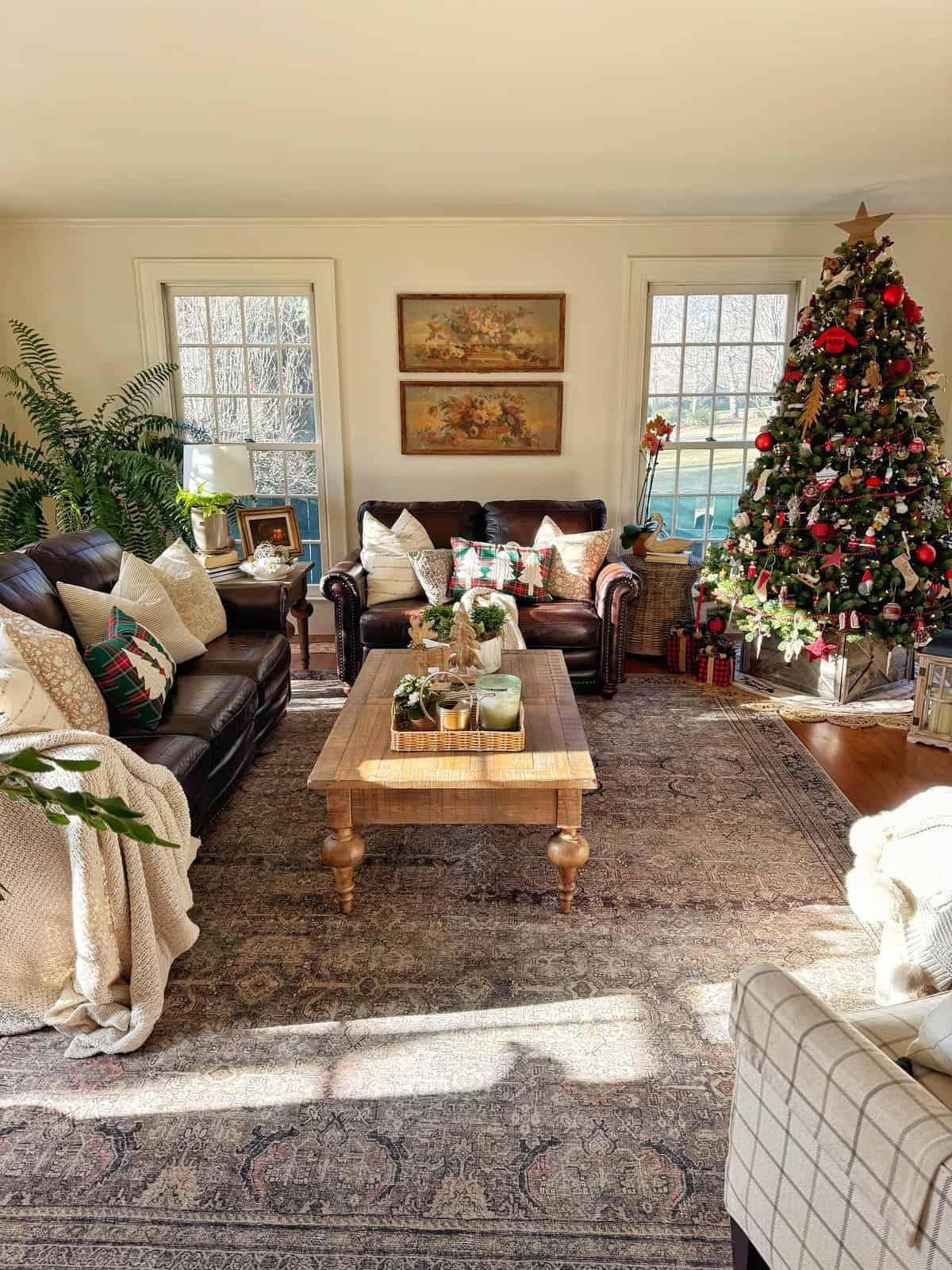
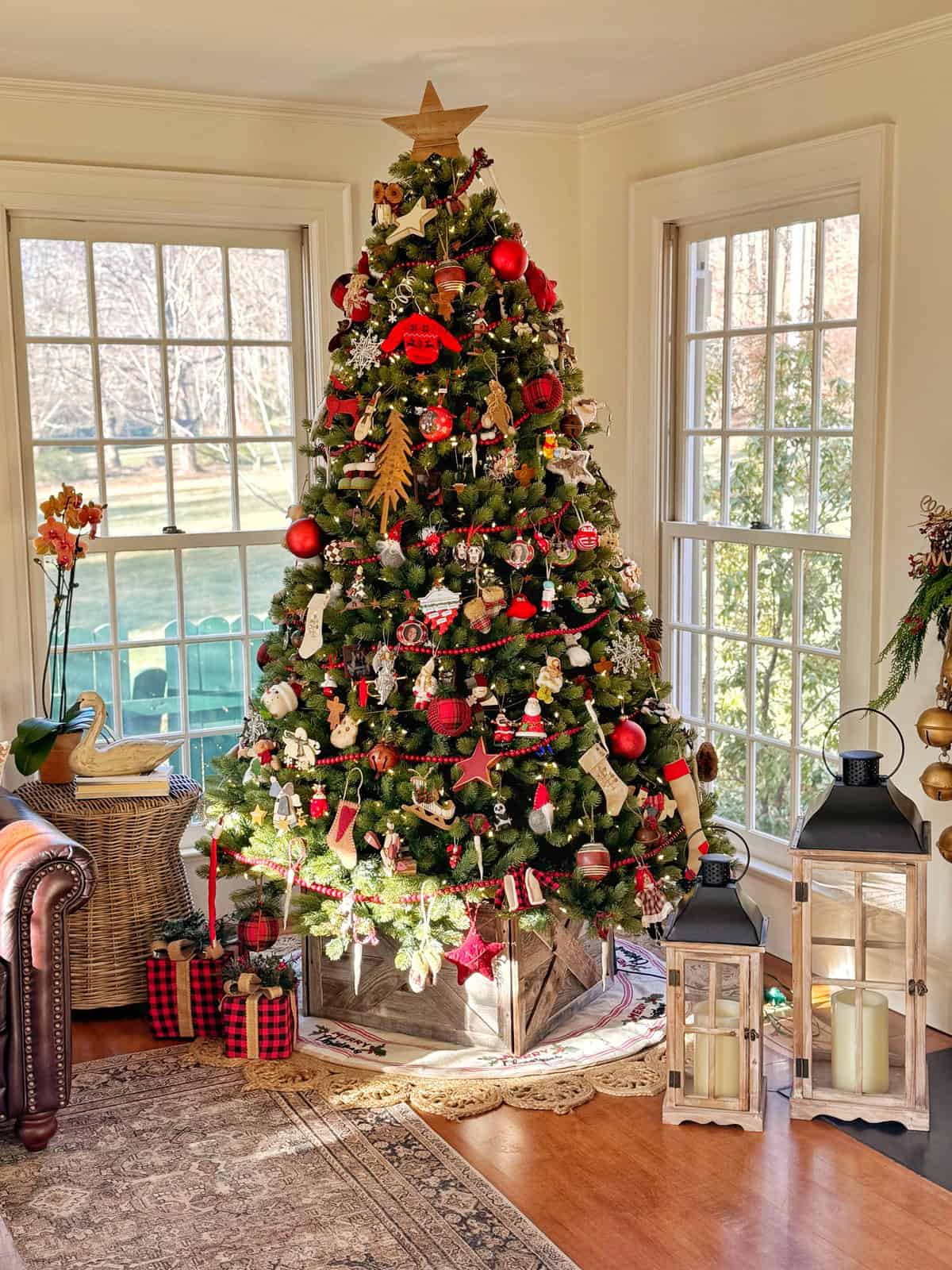
The 7.5′ Royal Fir Christmas Tree with 1000 LED Lights is hands down the best faux tree I own. It was the first one that I started using and LOVED it from the initial set up. It comes in three pieces with a tree stand and took less than five minutes to set up.
It was like instant Christmas.
The needles on this particular tree look incredibly authentic and very full. So unless you walk up and actually touch the tree, it looks incredibly authentic. And I am saying this as someone who grows stuff!
Not gonna lie, it’s a little pricey with the lights, but well worth it in my opinion as I’ve reliably set this up and taken it down by myself for like seven years now. You can also get it without the lights and just buy your own cluster lights if you want save a few dollars. But I can’t stress how full, pretty and twinkly this particular tree is with the lights that come with it. Speaking of which, haven’t had an issue with the pre-strung lights either!
I highly recommend it.
My Flocked Christmas Tree
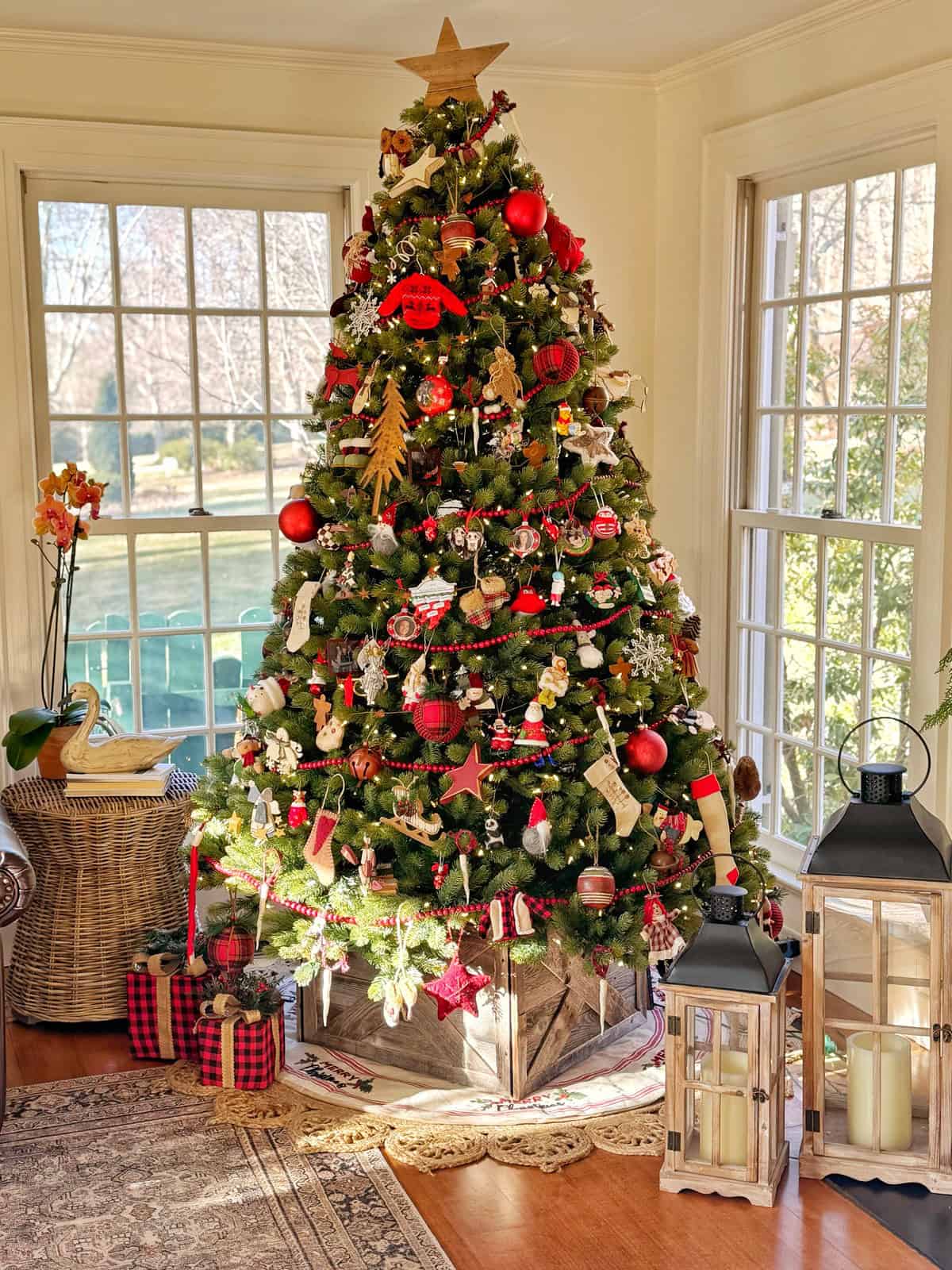
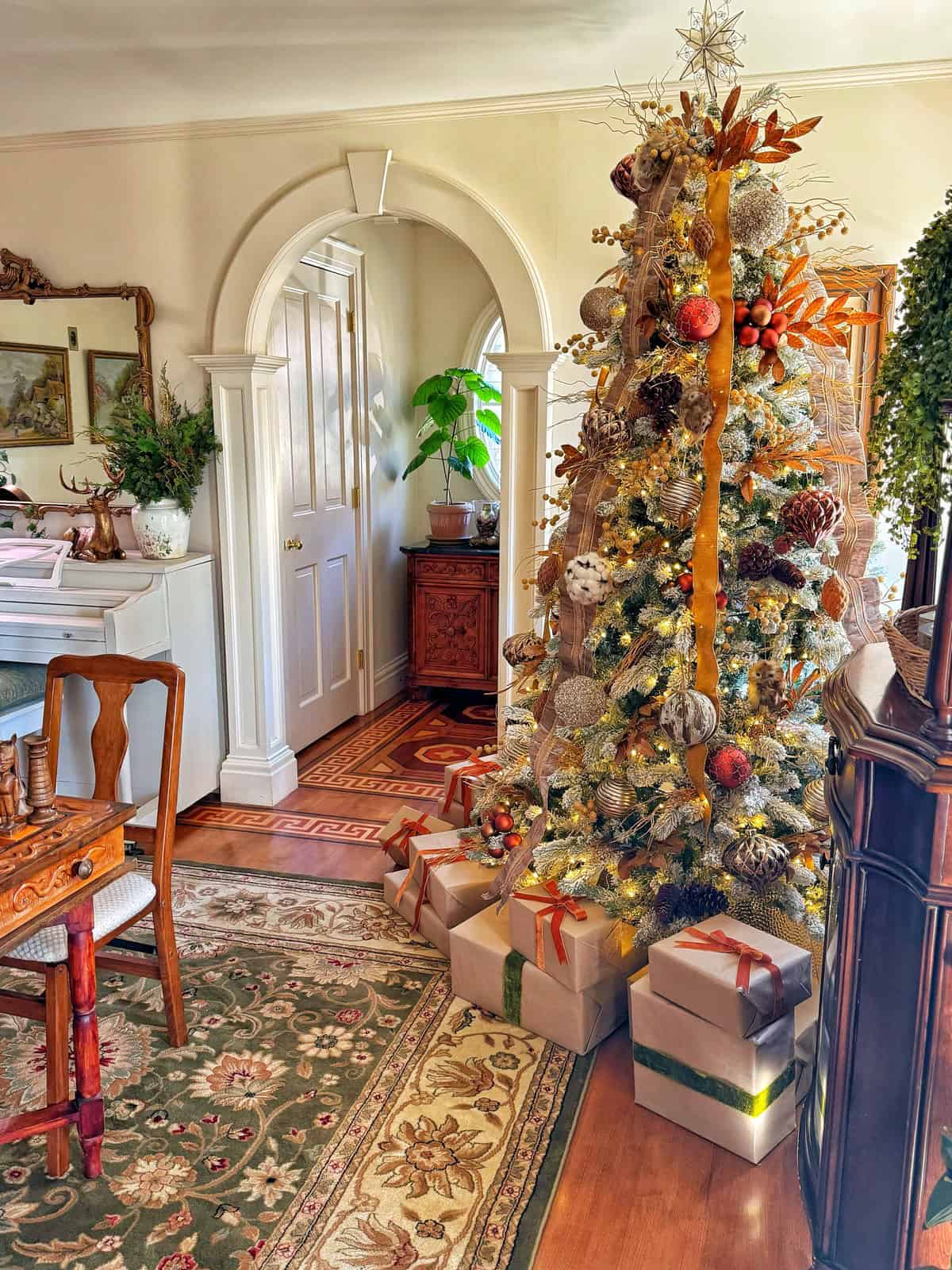
When we moved here back in 2021, I wanted to create a winter wonderland in the front entry hall. So I decided to try a flocked Christmas tree and have not looked back! I chose the 7.5′ King Flock with 800 LED lights because it is full, had great reviews, and was exactly what I was looking for.
After acquiring this particular tree, I added other flocked trees to my home from different brands, and can honestly tell you that the King Flock is the most well made-flocked tree I’ve had. All flocked trees will shed some flocking when you move it around or set it up, but this particular tree’s flocking was much less messy than others.
It looks more authentic than other flocked trees, it’s super easy to set up and take down, and comes with LED white lights. You can get it without the lights too but after messing around with lights every Christmas, I will buy the tree with pre-strung lights every time.
If you are looking for a good quality flocked tree, you can’t beat the King Flock from King of Christmas.

My Yorkshire Fir
I added a 7.5 foot Yorkshire fir with 600 Warm LED lights to our Vermont Cabin and have meh feelings over it. It’s pretty, it looks OK, but the branches and foliage look and feel a little less authentic than the other two faux Christmas trees I ordered from King of Christmas. Since we use this at the cabin, I keep it undecorated for a super, rustic look.
It’s full, easy to assemble and the lights are amazing, but the authenticity of the look is where I feel like it’s lacking. It is a bit less expensive, but I don’t LOVE this tree like I do the first two I mentioned. I don’t love that it has less lights than the other two either. If I were to buy another tree, this would not be my first choice.

My Scarlet Fir
Because I wanted to change things up for my family room, I decided to try the 7.5′ Scarlet Fir with 800 LED lights from King of Christmas. Much like the others, it is easy to set up and take down and looks pretty. This tree looks very full but I don’t love the foliage on it and think it lacks some authenticity in the foliage.
Given I have two other trees more pre-strung lights, the lack of 200 lights is also noticeable on this particular tree. I’m actually considering purchasing cluster lights like these to make this tree a bit more twinkly. When I ordered this, I thought it would look much better than it does.

Final Verdict: Which Tree is Right for Your Home?
Ultimately, the choice comes down to weighing tradition and scent against savings and sanity.
For me, the winner is clear. I’ve traded the hassle of the annual mess, the watering anxiety, and the needle drop for a high-quality tree I can put up whenever I want and enjoy for a full two months.
If you are tired of the real tree headaches, know that an investment in a great faux tree in the $450–$650 range is a gift you give your family that lasts for years.
Which camp are you in this year? Let me know in the comments if you have any questions about the cost comparison or finding the right PE tree!
Thank you for visiting the blog today!
Enjoy your day! xo

Originally Published .

Stacy,
We switched because there is always mold in the real trees. I was so sick every Christmas until I realized what was happening. Once we switched, I was never sick again!
Isnt’ that something? How long did you have a real tree for? We were always so emphatic about having a real tree and then that one year made us realize it was too much!