
The Garden Design Secrets Chanticleer Does Better Than Anyone

Discover the garden design secrets Chanticleer does better than anyone, and how to steal these ideas for your own home garden.
If you’ve been searching for garden design ideas that actually translate to a real home garden, Chanticleer in Wayne, Pennsylvania is the place that will change how you think about your outdoor space.
Unlike many public gardens that feel polished to the point of being untouchable, Chanticleer feels different because it’s immersive, artistic, relaxed, and surprisingly achievable. Every corner reveals something unexpected. Every path leads somewhere you didn’t anticipate. And almost everything you see feels like something you could actually try at home. For serious gardeners looking to elevate their design thinking, it is one of the most important gardens on the East Coast.
I’m Stacy Ling, a trained master gardener with nearly 30 years of gardening experience in Zone 6b, New Jersey. I’ve spent decades studying not just plants, but how gardens function and feel: how a planting combination creates emotion, why some spaces feel alive and others feel flat, what separates a beautiful garden from a truly memorable one.
I’ve walked through some of the most celebrated gardens in the Northeast, and Chanticleer stands in a category of its own. What follows are the ten design secrets I observed walking through Chanticleer and exactly how you can apply each one in your own garden.
(Posts on stacyling.com may contain affiliate links. Click HERE for full disclosure.)
Watch: 10 Garden Design Ideas I’m Stealing From Chanticleer
See these design ideas in action as I walk you through the garden in this video and then keep reading for the deeper dive into each one.

What Makes Chanticleer Different From Other Public Gardens
Before diving into the design ideas themselves, it’s worth understanding what makes Chanticleer so unusual. Unlike display gardens designed to showcase plant collections or impress with sheer scale, Chanticleer is managed by a small team of horticulturists who each have creative ownership over their own garden areas.
The result is a garden that feels personal, experimental, and genuinely alive…because it is. Each section reflects a distinct creative vision, which is why the garden never feels repetitive even as you move through dramatically different spaces. It feels less like a botanical institution and more like stepping inside the mind of an exceptionally creative gardener.
That distinction matters, because it means the ideas here aren’t the result of massive institutional budgets or crews of maintenance staff. They’re the result of people who love plants, pay close attention to how spaces feel, and aren’t afraid to try things that might not work. That’s something any home gardener can relate and aspire to.
1. Letting Plants Touch and Weave Together
One of the first things you notice walking through Chanticleer is how connected everything feels. Plants aren’t sitting in isolation with visible mulch between them. They’re weaving together, leaning into each other, spilling across pathways, and layering in ways that feel completely natural.
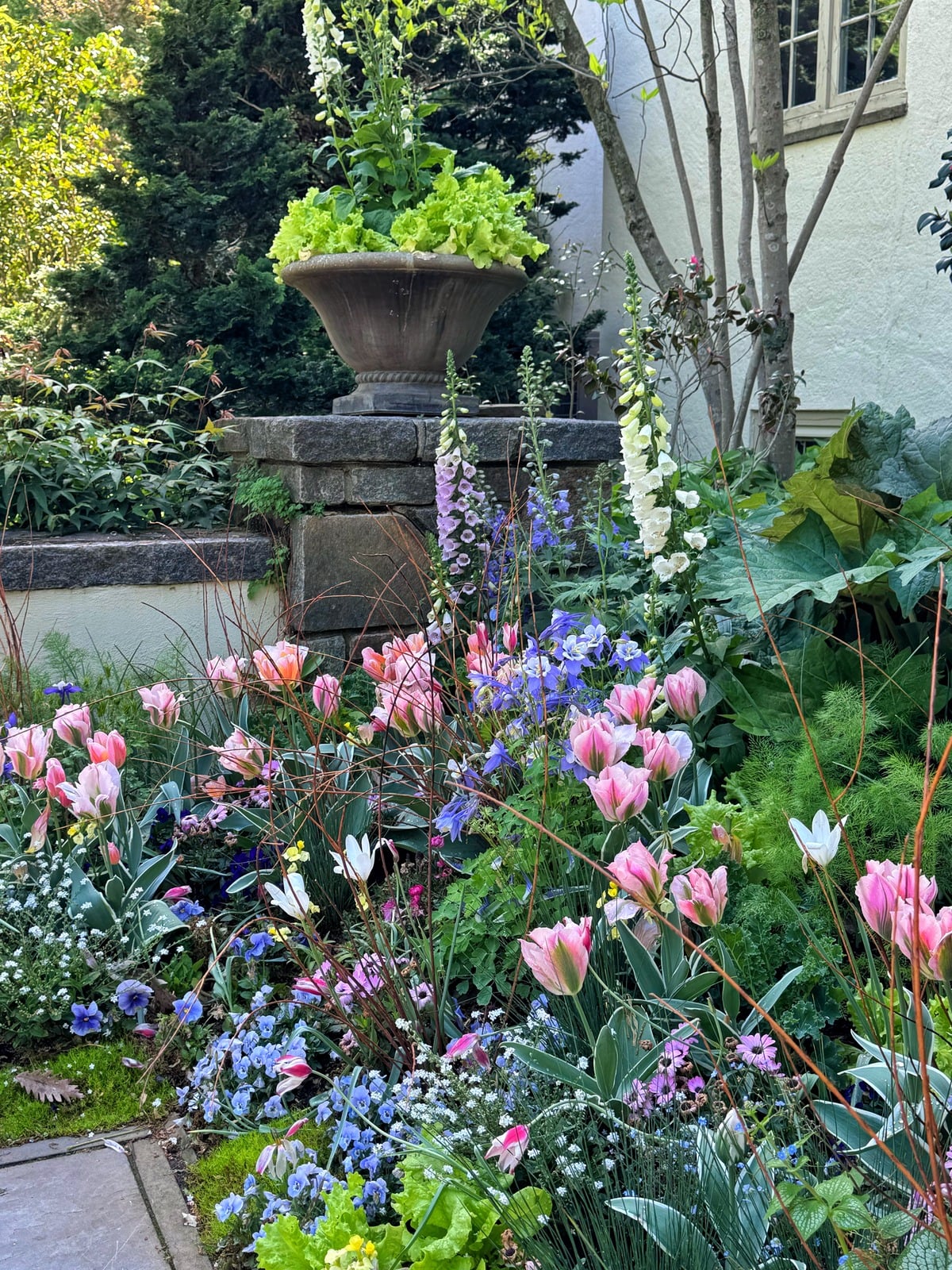
In one of the spring borders, pink lily-flowered tulips grow up through forget-me-nots and pansies, with delphinium and foxglove rising behind them, bronze fennel threading through everything, and the bold architectural leaves of rhubarb anchoring the back. Nothing is planted in a tidy row. Nothing is given so much space that it looks lonely. The plants intermingle the way they would if they’d seeded themselves there over years because in some cases, they have.
This is a principle that runs counter to a lot of conventional gardening advice, which tends to emphasize proper spacing and clean separation between plants (my own advice included). And while proper spacing absolutely matters for air circulation and plant health, there’s a significant difference between giving plants room to grow and keeping everything so controlled that the garden never achieves that feeling of abundant softness.
In my own Zone 6b garden, I’ve found the most beautiful moments happen when I stop being so precious about boundaries and let plants find each other. Larkspur self-seeding between tulips. Salvia threading through nepeta. Borage flopping gently into a neighboring drift of roses. The garden starts to feel like it has a life of its own, and that’s exactly the feeling Chanticleer has perfected.
Try it at home: Resist the urge to deadhead every spent bloom before it has a chance to self-seed. Let your forget-me-nots, foxgloves, and columbines move around. Plant bulbs through groundcovers rather than in isolated patches. The controlled messiness is the point.
2. Repeating Forms Instead of Exact Plants
Something I kept noticing throughout Chanticleer was how often forms and shapes were repeated across different areas, not necessarily identical plants, but the same visual language echoed through the space.
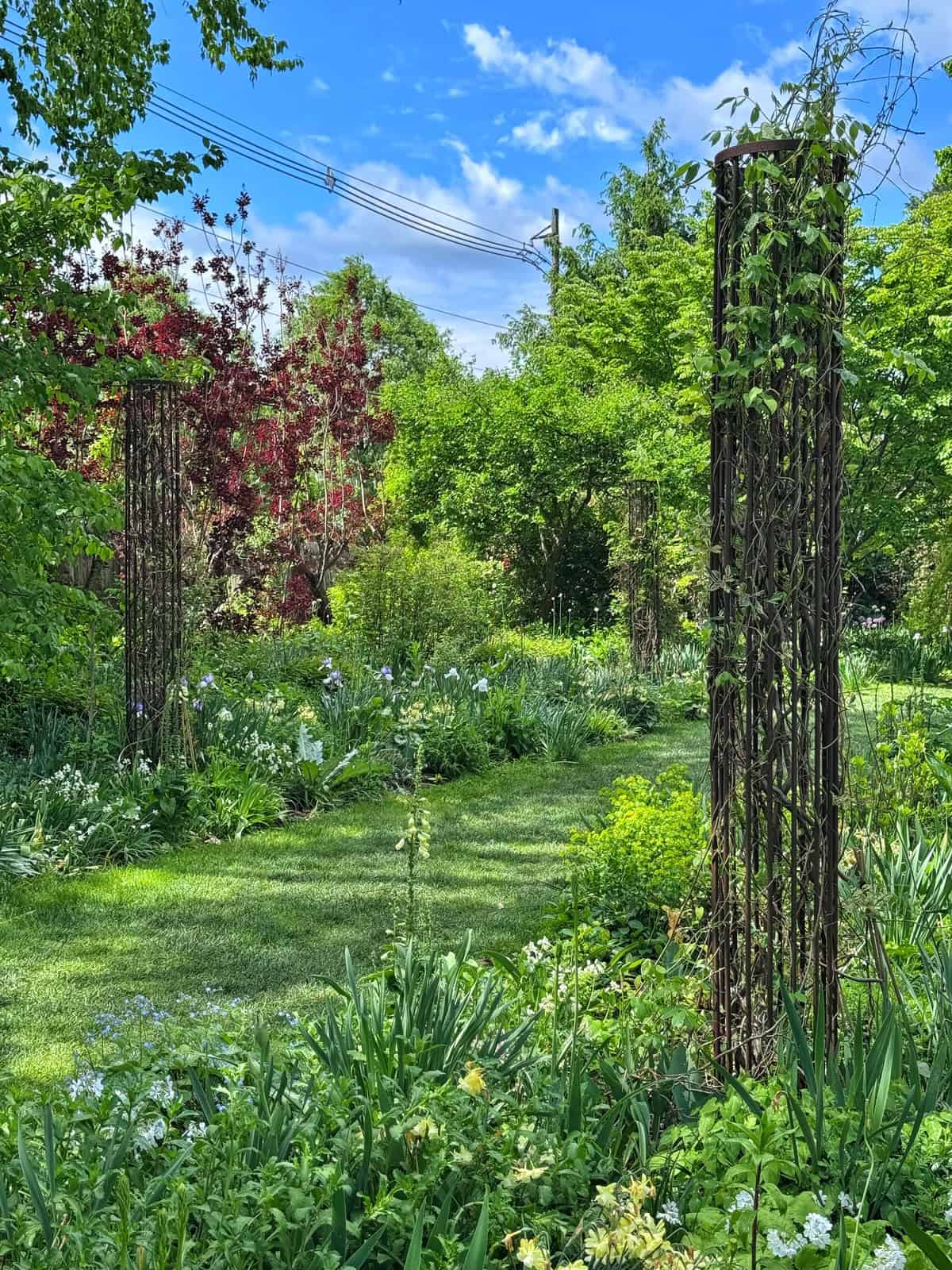
Tall dark metal obelisks appear in multiple garden areas, their vertical lines repeated even as the plants around them change completely. Purple alliums float through the meadow planting, their perfect spheres reappearing in different scales and slightly different shades across multiple sections. The airy, cloud-like quality of euphorbia echoes the billowing texture of cow parsley elsewhere. Rounded clipped boxwood forms appear intermittently through more informal plantings, providing a rhythm that keeps the eye moving.
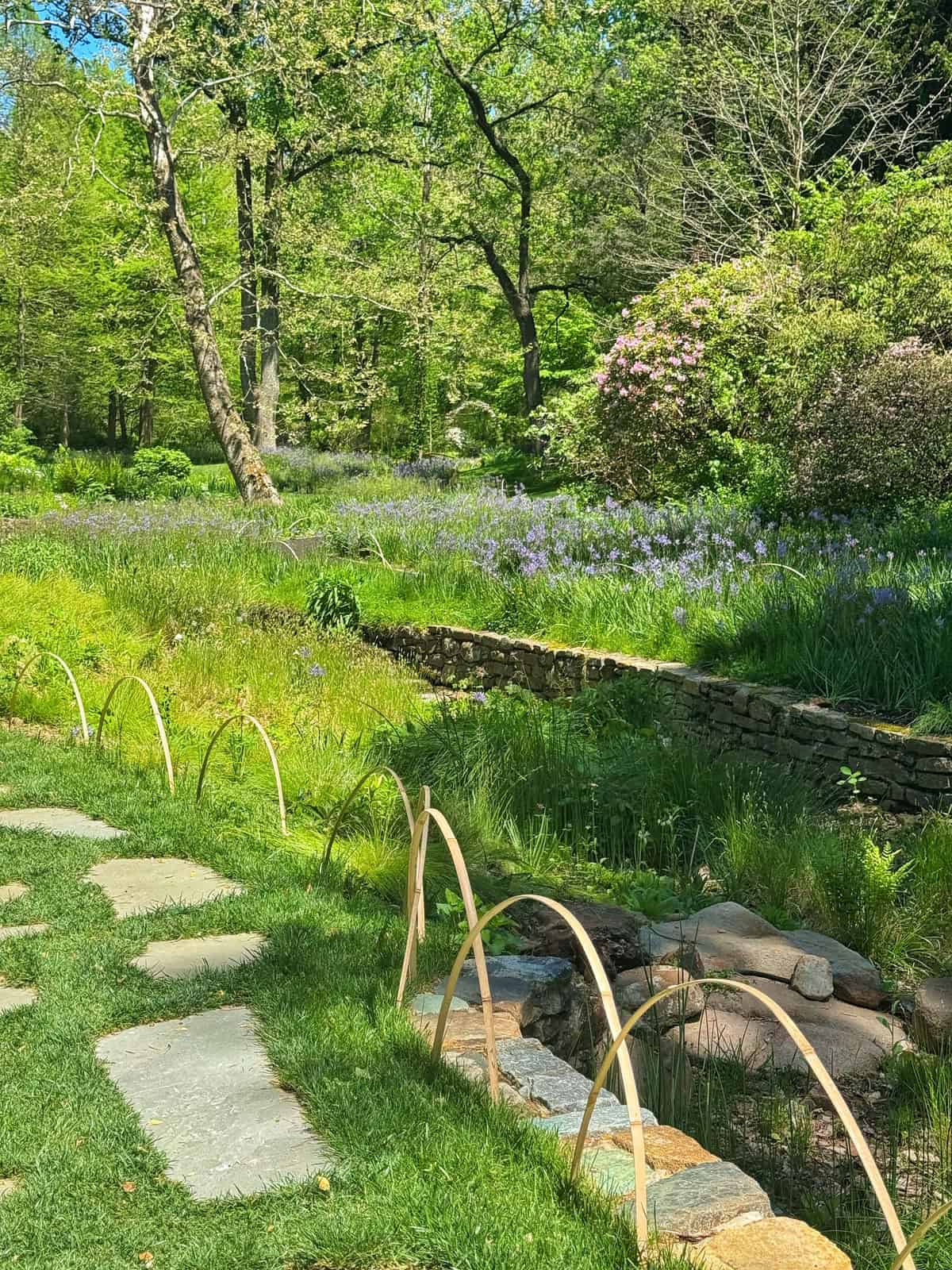
This is one of the most practical design lessons Chanticleer offers, because it doesn’t require an enormous plant budget or rare specimens. Repeating a shape. A vertical element, a rounded form, a fine-textured plant, or an airy umbel creates cohesion across a garden space without making it feel formal or rigid. You don’t need massive drifts of identical plants to achieve harmony. You need the same visual conversation happening in multiple places.
In a home garden, this might mean using the same style of container in different sizes across multiple areas, or repeating a specific plant form with for example, ornamental grasses, throughout different beds even when the specific cultivars vary. The eye recognizes the pattern and the garden feels intentional rather than random.
Try it at home: Walk your garden and identify one plant form you love like a vertical spike, a rounded shrub, an airy umbel. Then ask yourself: where else could I repeat that? Three repetitions of the same form in different spots will do more for your garden’s cohesion than any amount of color coordination.
3. Blending Plants With Architecture So They Become One
This was honestly my favorite thing about Chanticleer, and the thing that stayed with me longest after leaving. The architecture and planting here feel completely inseparable, not because one is trying to complement the other, but because they’ve genuinely grown together into something unified.
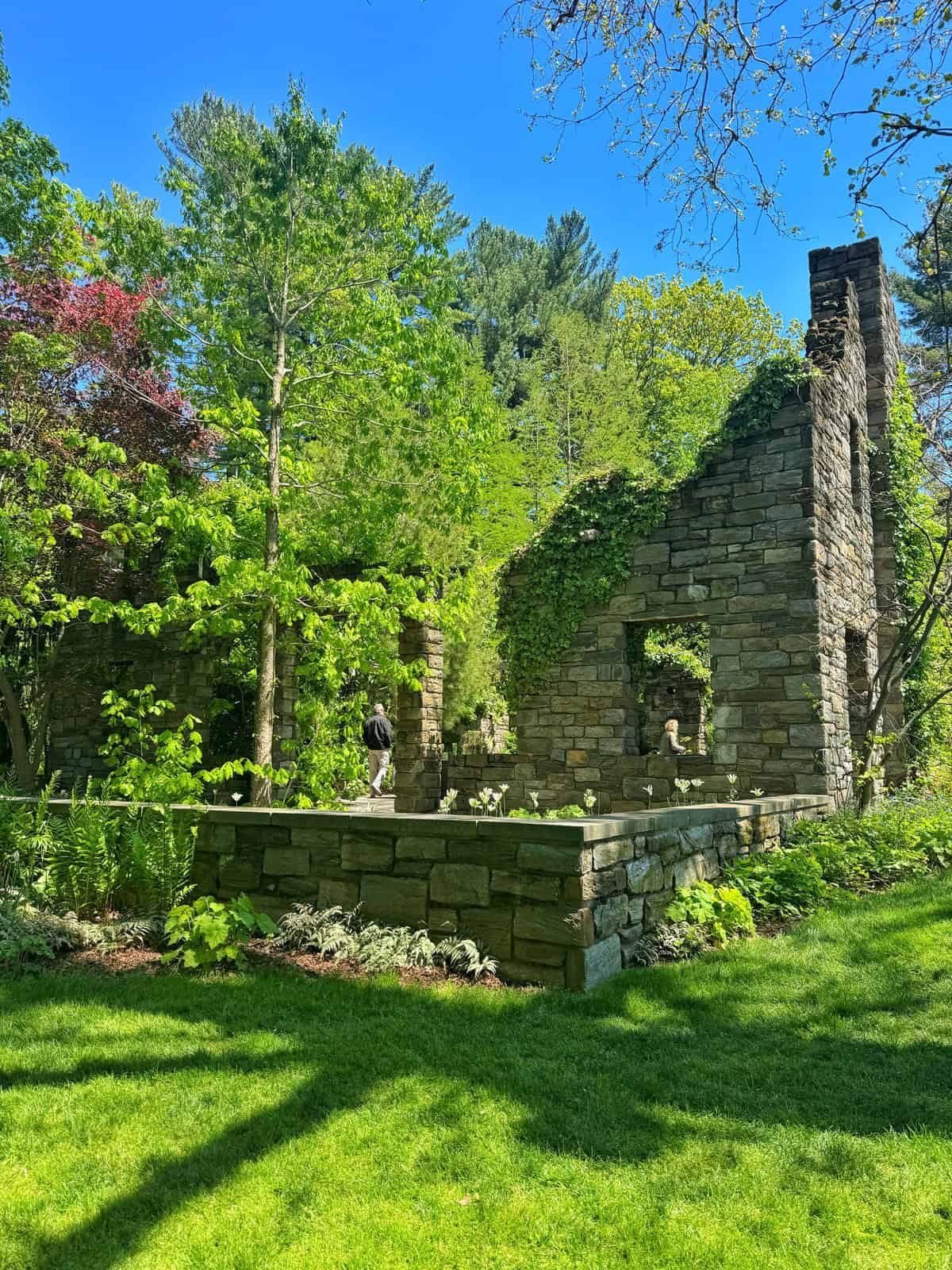
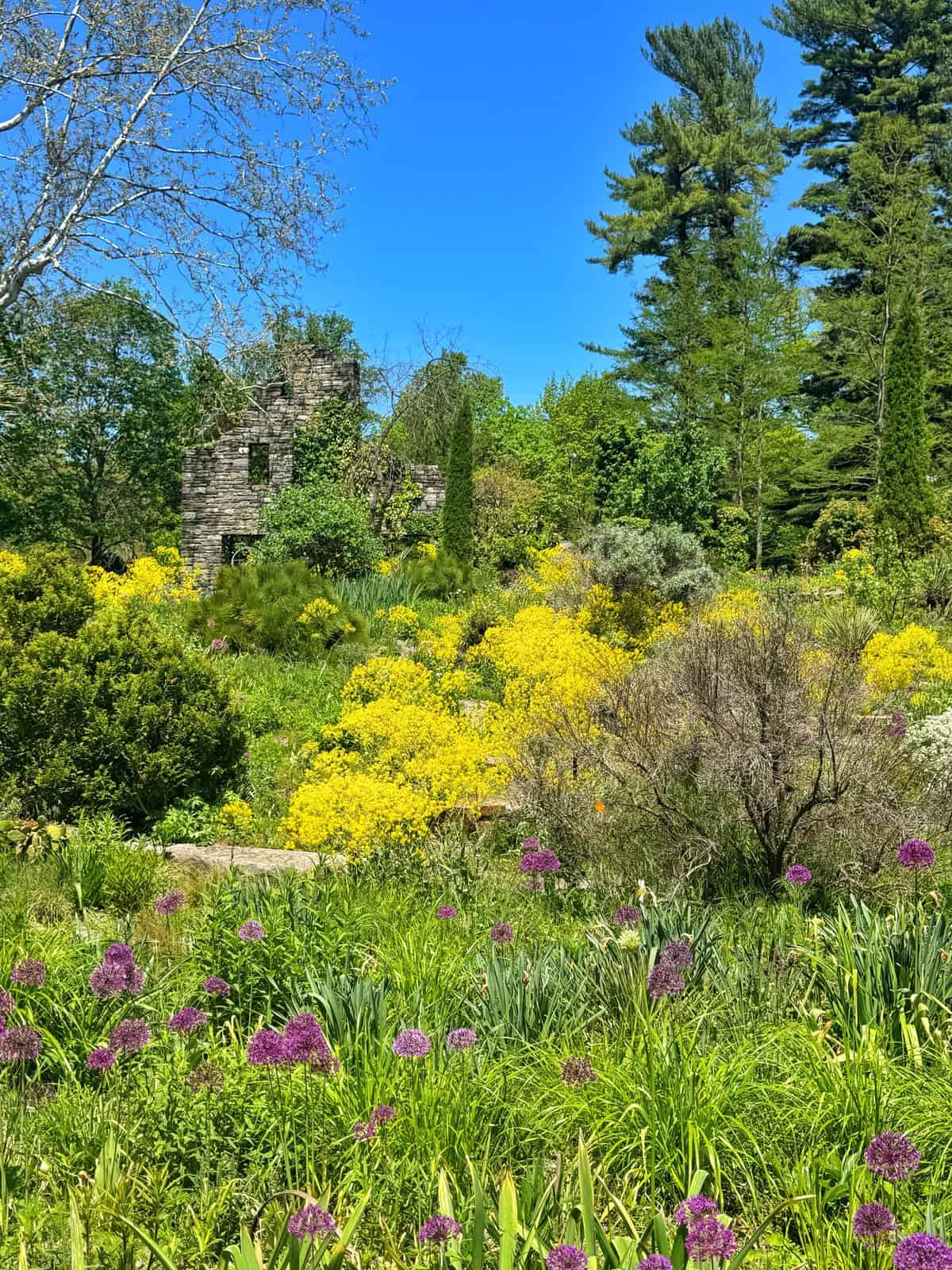
The stone ruin folly is perhaps the most dramatic example. These roofless stone walls with empty window openings sit on a hillside surrounded by sweeping masses of acid yellow euphorbia and purple alliums, and the effect is extraordinary. The ruins look genuinely ancient. Ivy has claimed the walls. Ferns and white anemones grow inside the roofless rooms where floors once were. Trees have grown up through what were once interiors. The planting doesn’t decorate the architecture. It inhabits it.
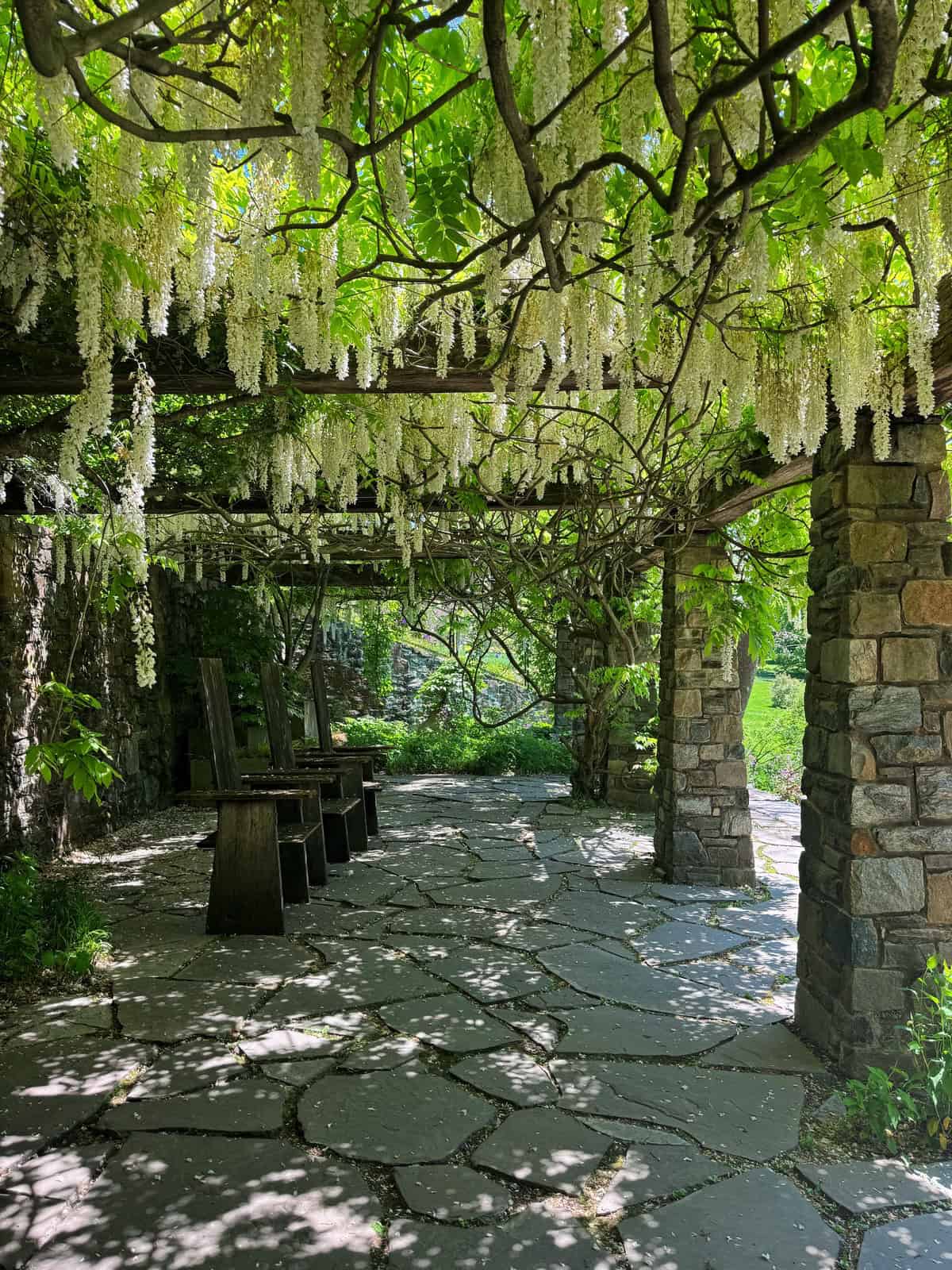
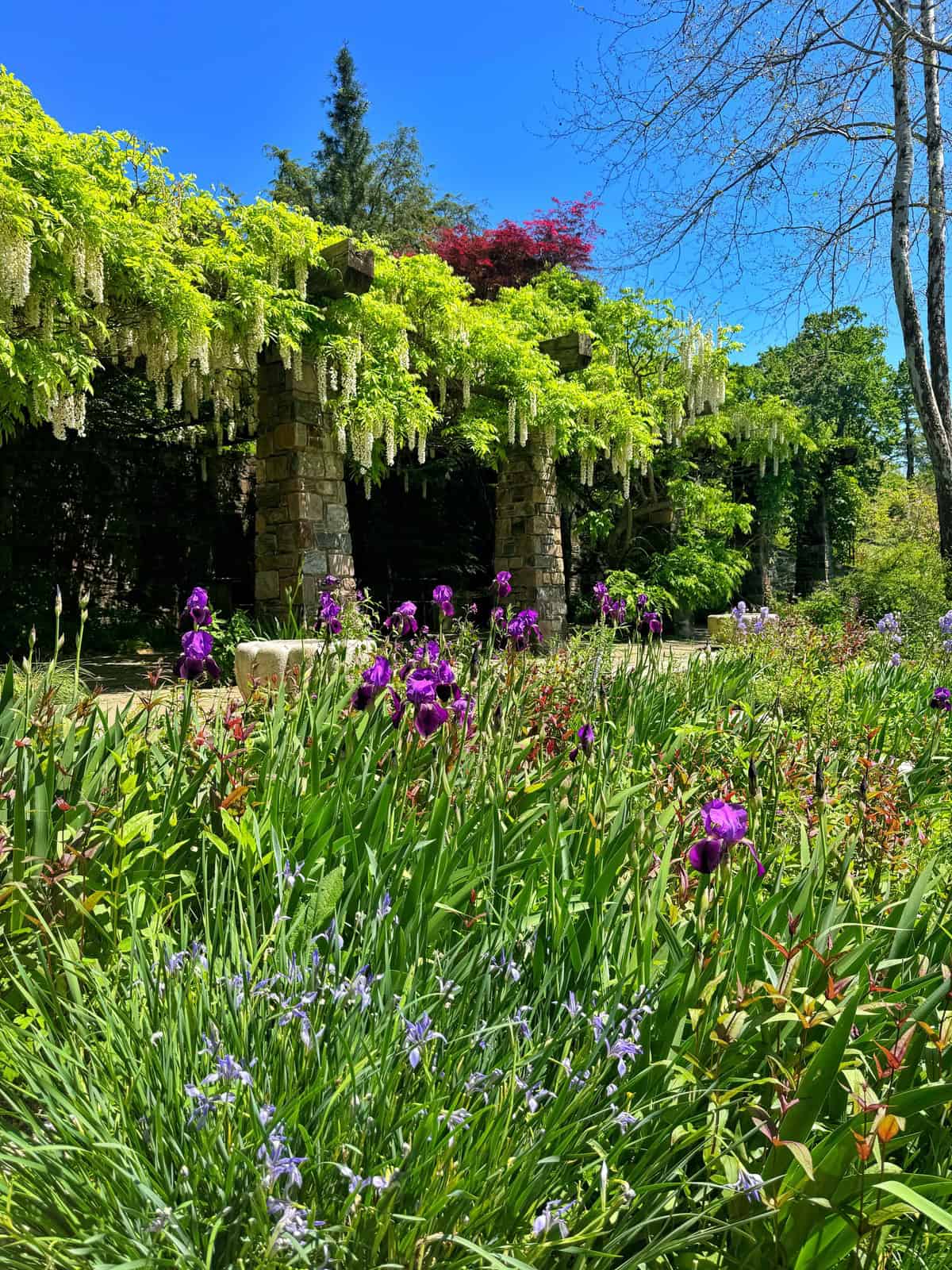
The wisteria pergola tells the same story. Stone columns support overhead beams that are now completely consumed by white wisteria in full bloom, the racemes hanging like chandeliers over the deep purple bearded iris and blue scilla planted below. The stone is barely visible. The architecture has become a scaffold for the garden.
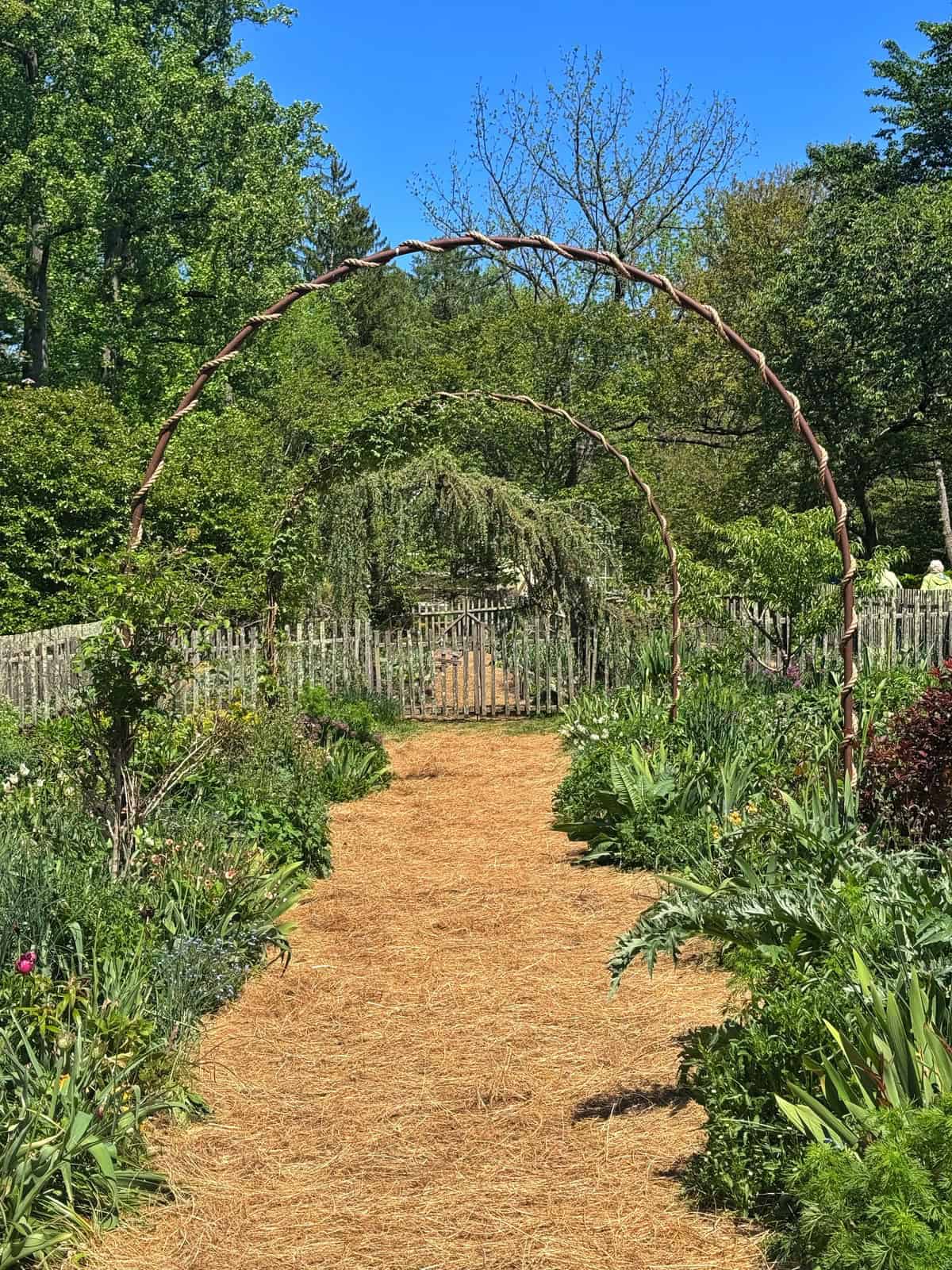
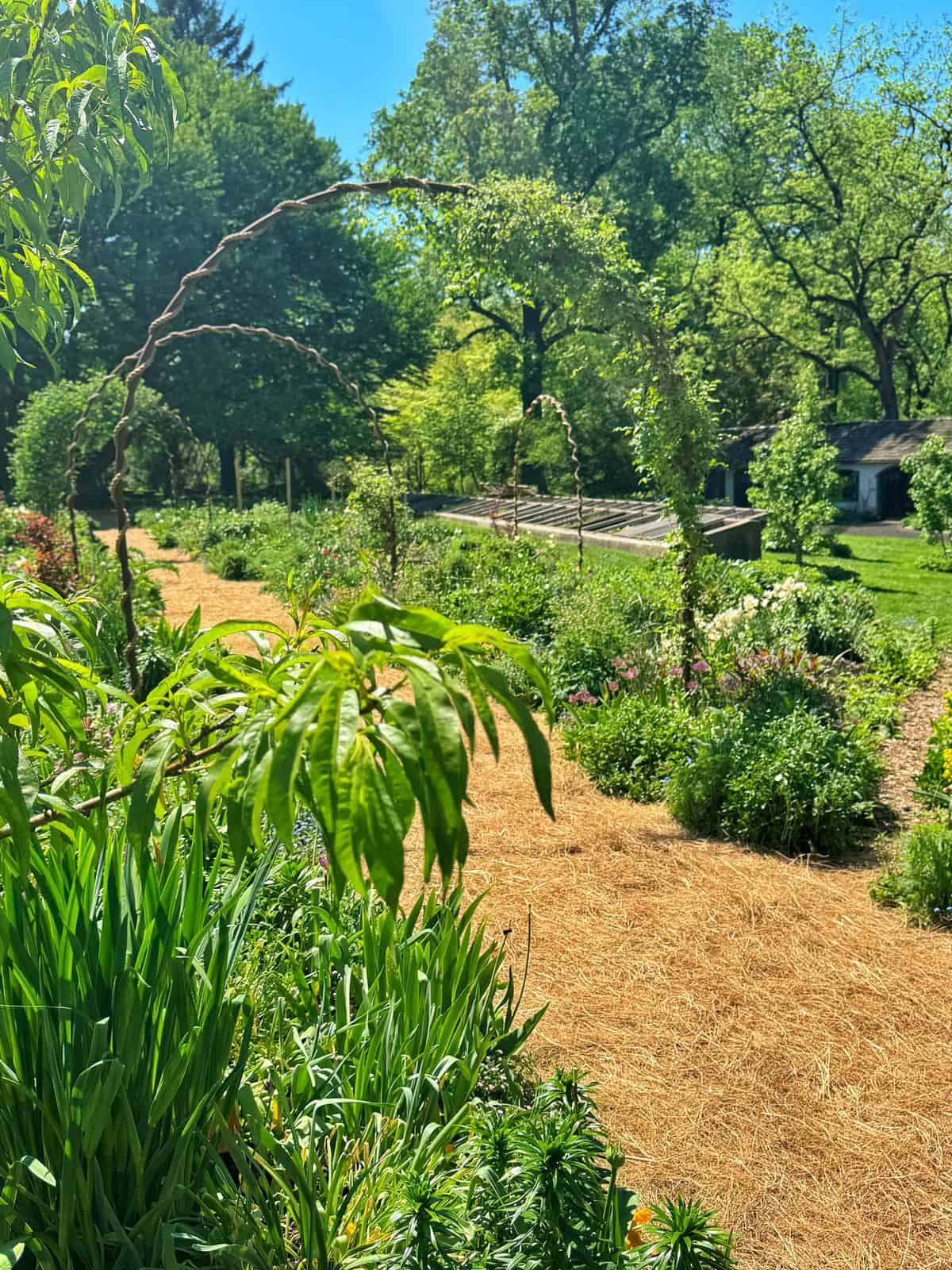
Even the handmade willow arch over a pine needle path is a simple, almost rustic structure twisted from natural branches that feels completely of a piece with its surroundings. The garden doesn’t look designed. It looks grown.
For home gardeners, this is one of the most transformative ideas in the entire garden. If you have a fence, a pergola, an arbor, a stone wall, or even a simple trellis, consider how planting can dissolve its edges rather than simply sit beside it. Let clematis climb. Let roses consume. And let the self-seeders colonize the cracks. The goal is to make the structure feel like it emerged from the garden rather than being placed in it.
Try it at home: Pick one structural element in your garden, even a simple fence post, and ask how you could begin to soften it with planting. Climbing roses, annual vines, or self-seeding foxgloves growing at the base are all starting points. The architecture should feel like it belongs to the garden, not the other way around.
4. Using Foliage as the Foundation, Not the Afterthought
Chanticleer does something that I think most home gardeners severely underutilize: it treats foliage as the primary design element and lets flowers be the seasonal bonus.
Even in areas where little is actively in bloom, the gardens remain richly layered and visually interesting because the foliage textures are so dynamic and thoughtfully composed. Fine bronze fennel next to broad hosta leaves. Glossy camellia against the matte silver artemisia. Airy ornamental grasses threading between dense rounded shrubs. The deep burgundy of canna foliage with varieties like ‘Australia’ or ‘Tropicanna Black’ paired with caramel and copper heuchera creating a warm foliage combination that reads almost like a flower combination from a distance.
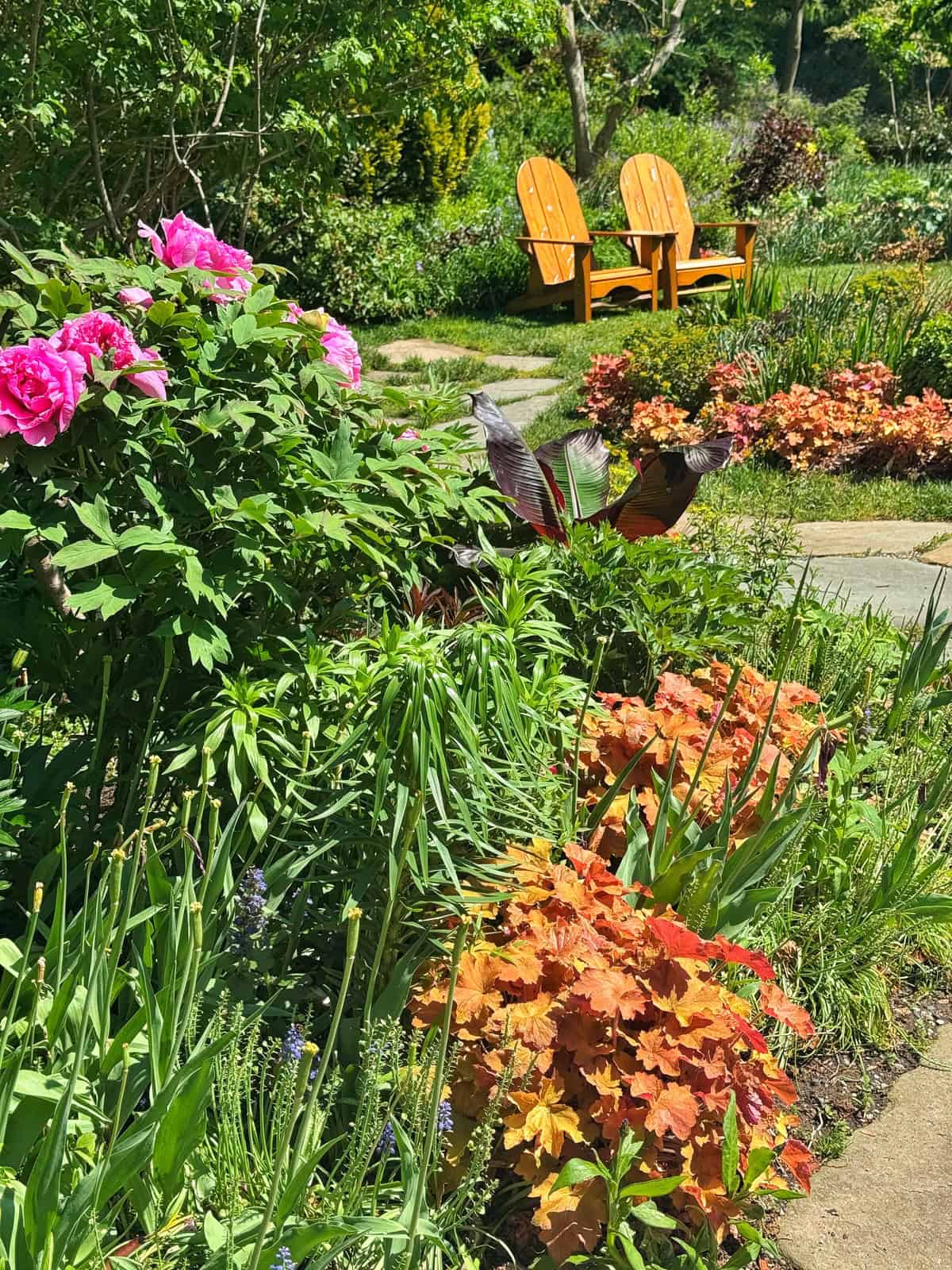
In one of the garden areas I photographed, a path is lined with pink tree peonies underplanted with ferns, the contrast between the huge silky blooms and the delicate fern fronds creating a moment that’s genuinely breathtaking. When those peonies finish, the ferns will carry the space beautifully through the rest of the season. So the design works beyond the bloom.
This is one of the biggest lessons I’ve taken from studying exceptional gardens over 30 years: a garden that relies entirely on flowers for visual interest will have significant gaps. Foliage is what carries a garden through. It provides the structure, the contrast, the backdrop, and the continuity that makes everything else look intentional.
Try it at home: Before adding another flowering plant to a border, ask what the bed looks like in late July when the spring bloomers are done and the summer annuals are just getting started. If the answer is “mostly green and not very interesting,” that’s a foliage opportunity. Heuchera, grasses, hostas, ferns, and bold-leaved tropicals like cannas all solve this problem beautifully.
5. Creating Garden Rooms That Make You Want to Keep Moving
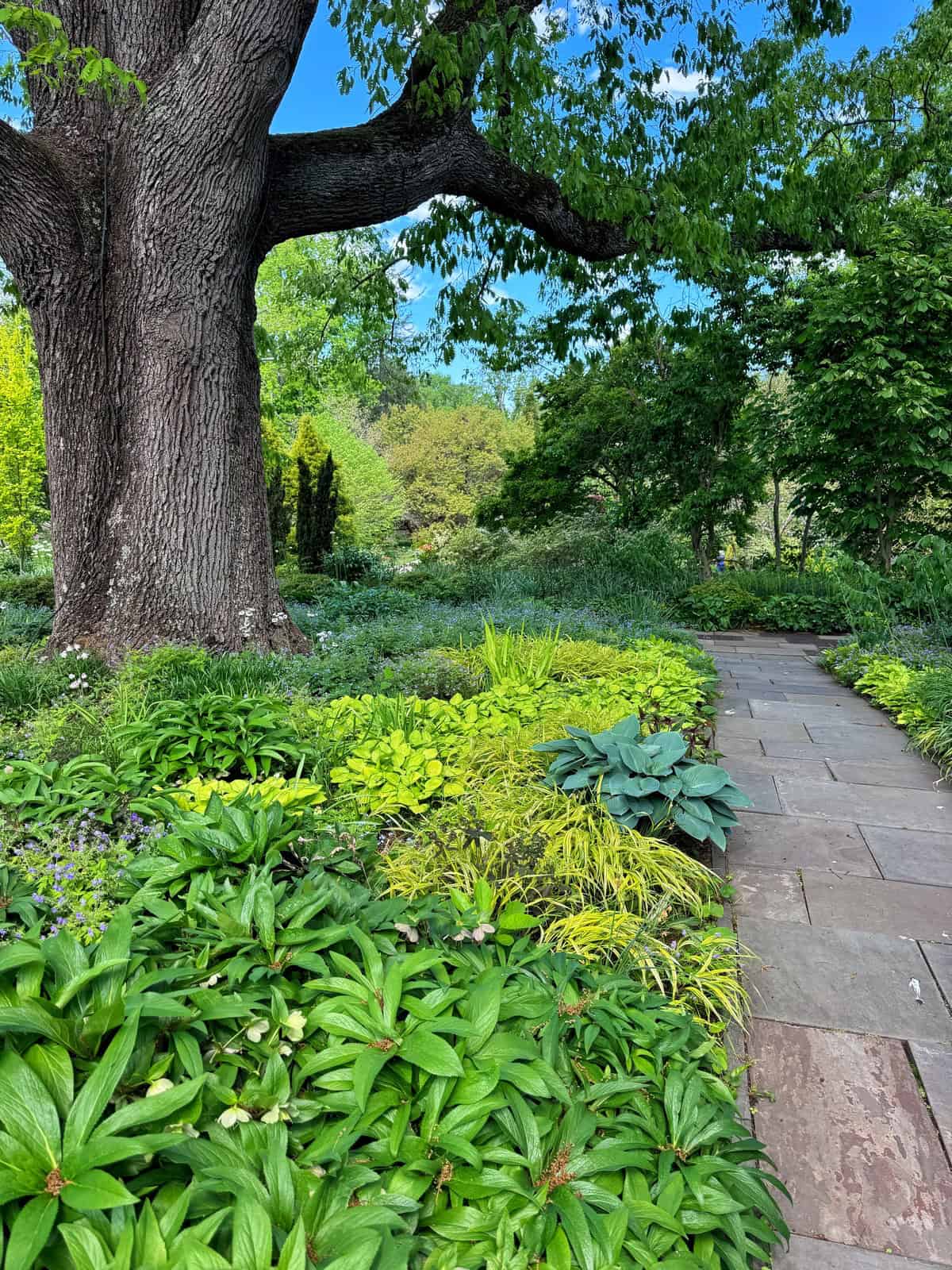
Walking through Chanticleer never feels repetitive, and the reason is that every area of the garden feels like its own distinct world. The transition from one space to the next is one of the most carefully designed elements in the entire garden, even though it never feels designed at all.
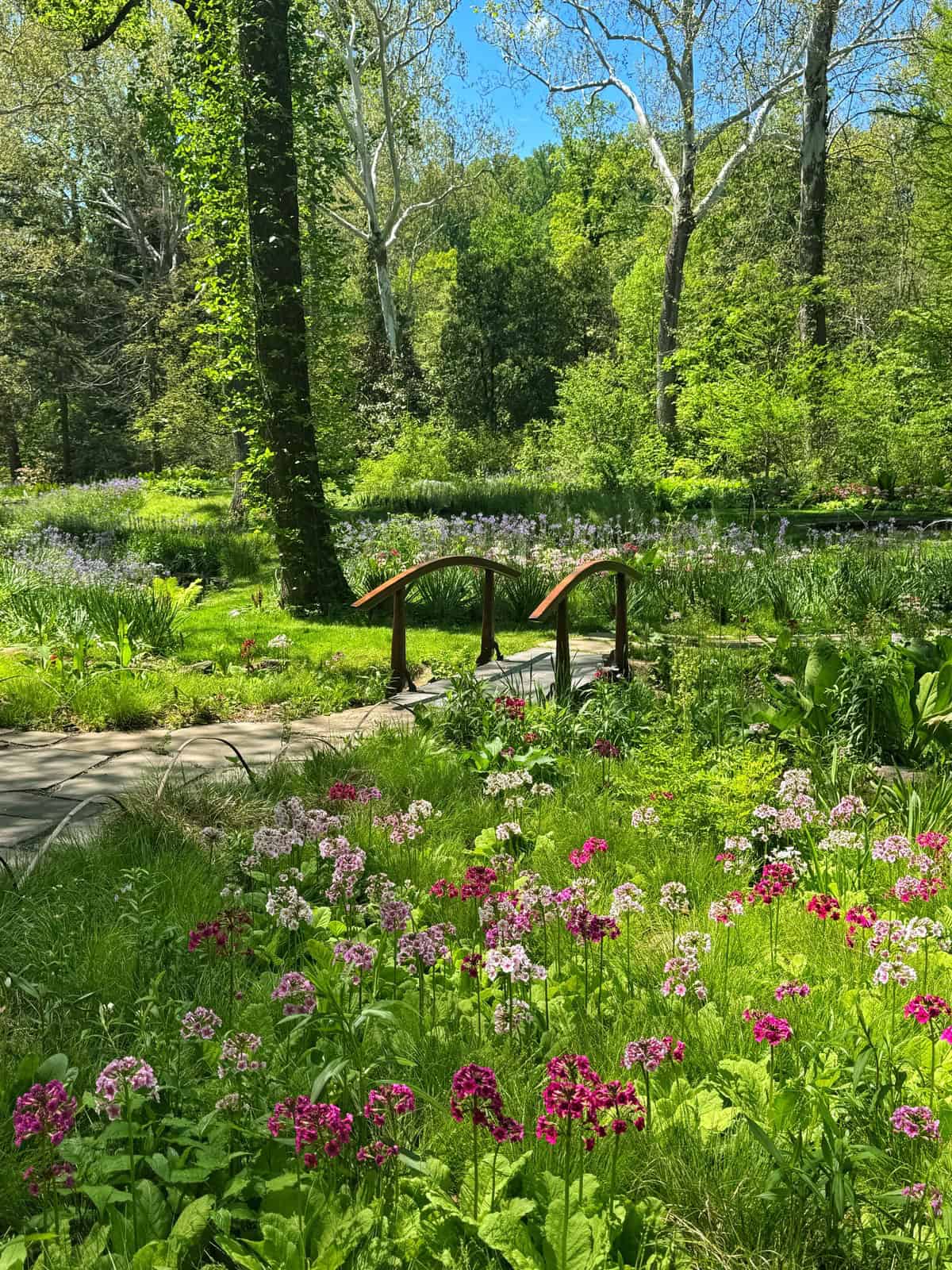
You move from an open meadow planting into a shaded woodland path mulched with pine needles, hostas and epimediums lining both sides, bamboo overhead, the path disappearing into shadow ahead. Then suddenly you emerge onto a lawn with a circular millstone water feature bubbling quietly at the center, candelabra primulas massed along a stream beyond, and a red Japanese bridge drawing the eye further into the distance. Then an iron gate opens onto a rose arch, and beyond the arch you can see another bridge, another area of planting, another thing to discover.
The garden reveals itself slowly. You never see it all at once. And that’s entirely intentional.
Each transition uses something physical to signal that you’re moving between worlds like a gate, an arch, a change in path material from stone to pine needles to mown grass, a shift from bright sun to deep shade. These thresholds are the punctuation marks of the garden’s narrative, and they’re what make walking through Chanticleer feel like reading a story rather than viewing an exhibit.
Even a small home garden can borrow this idea. A simple hedge that screens one area from another. A pergola that creates a moment of compression before opening to a wider space. A gate, even a symbolic one that isn’t actually meant to keep anything out, that invites you to pass through. The physical experience of moving between spaces is as important as what’s in each space.
Try it at home: Stand at your garden entrance and map out whether your garden reveals everything immediately or whether there’s something beyond each visible area. If someone can see your entire garden from one spot, think about what you could add like a screen, an arch, a change in level, to create sequential discovery.
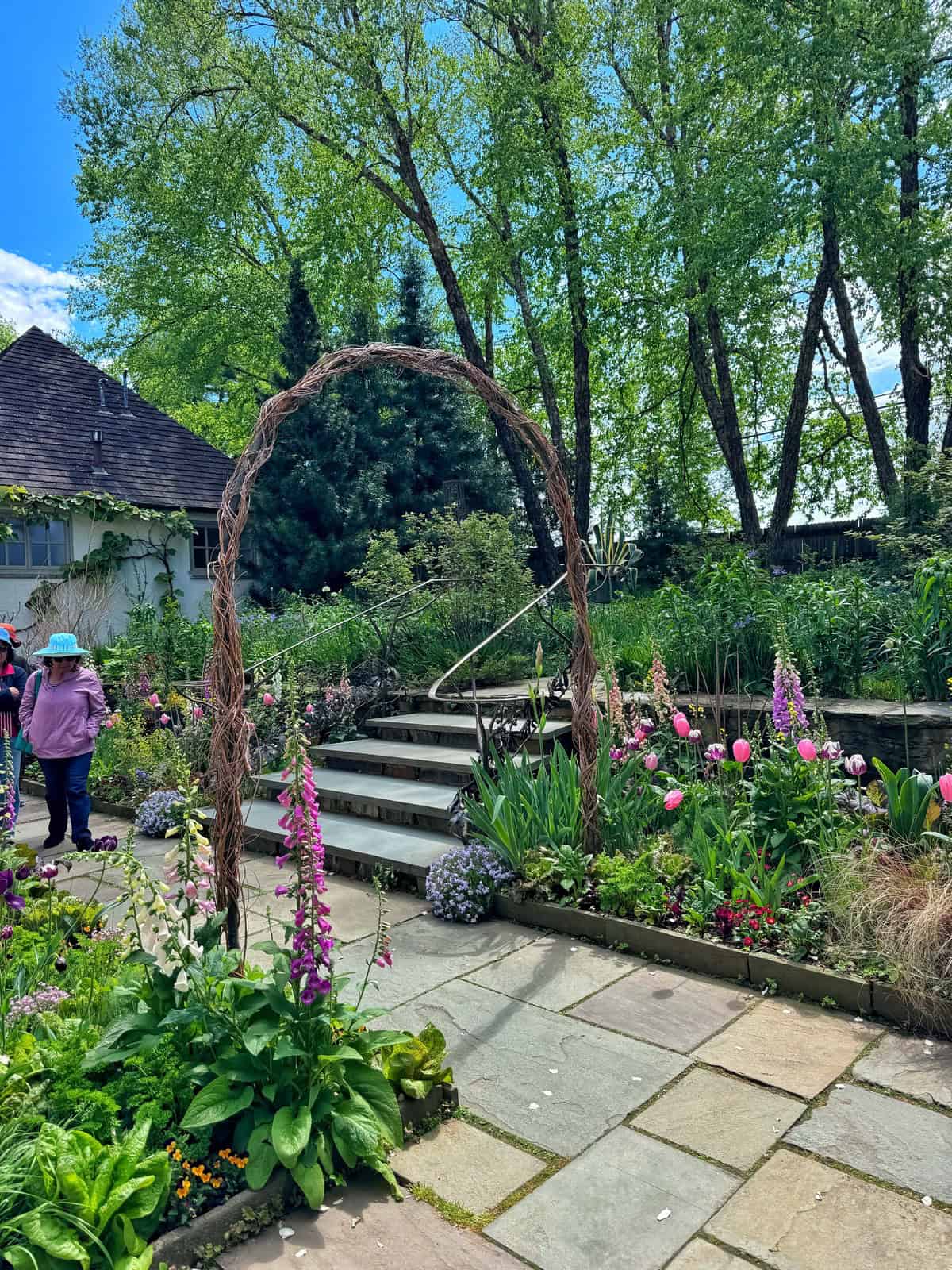
6. Using Unexpected Plants and Materials Creatively
One of the most joyful things about Chanticleer is that it gives itself permission to be experimental in ways that most gardens don’t. And the experiments aren’t loud or try-hard, but rather, they’re quiet, artful, and often surprisingly simple.
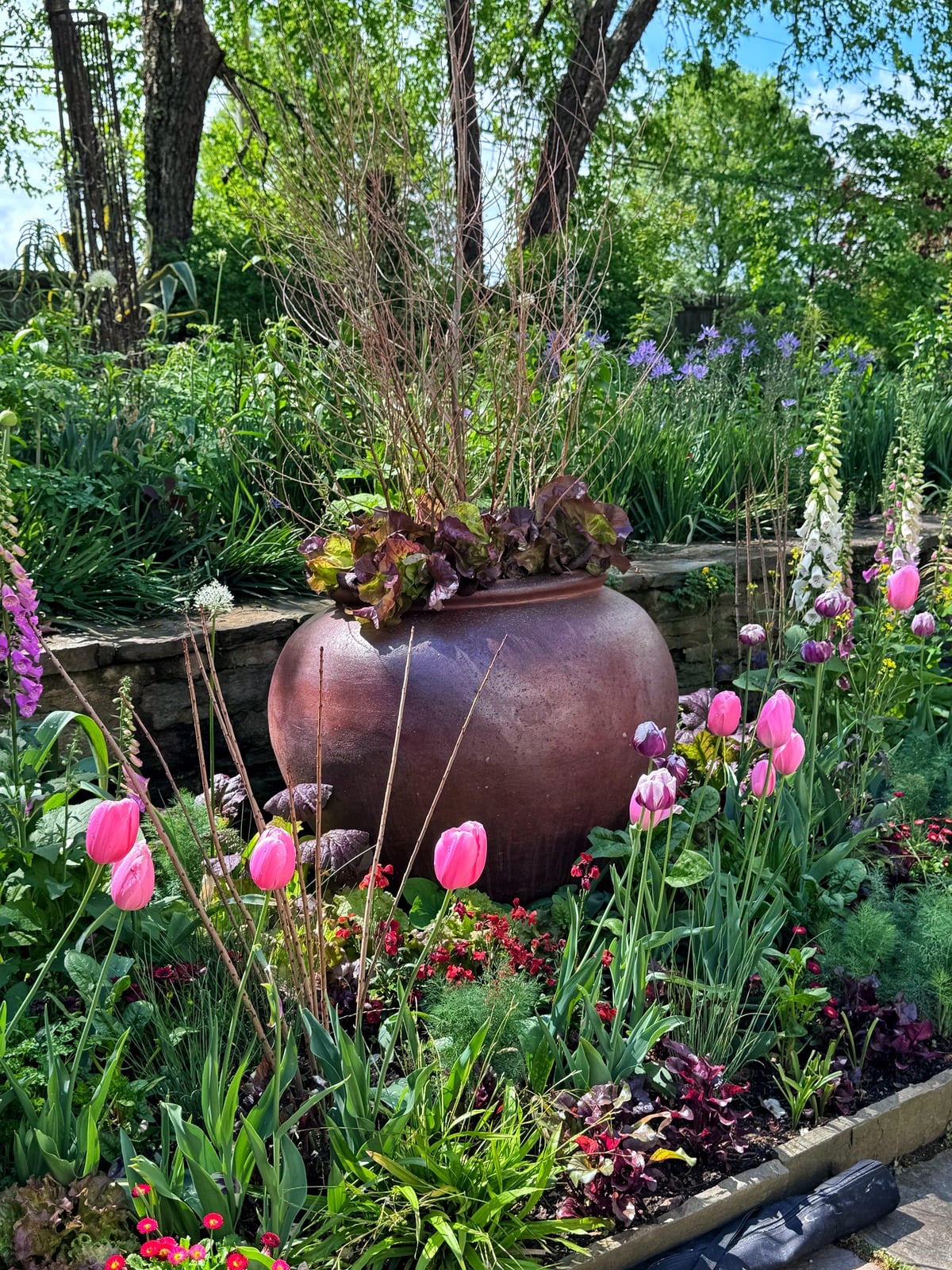
The container plantings in particular showcase this beautifully. A stone urn elevated on a plinth is planted with nothing but loose-leaf lettuce. The chartreuse ruffled leaves tumbling over the rim in a combination that is simultaneously practical and completely beautiful. A large round burgundy vessel is planted with red-leaf lettuce and upright dried branches, surrounded at the base by pink tulips, red ranunculus, and feathery bronze fennel. It’s edible and ornamental in one composition that would look equally at home in a kitchen garden or a formal border.
Elsewhere, a weathered Italian terracotta pot is planted simply with hot pink dianthus, with a collar of fine dried grass woven around the rim as a natural mulch detail that makes the whole composition feel considered and complete. Two matching rusted iron pedestal urns looking very much like repurposed architectural salvage, possibly antique fence post capitals, are planted with foliage-forward tropical combinations of cordyline, heuchera, and sedge, surrounded at their feet by a carpet of blue forget-me-nots.
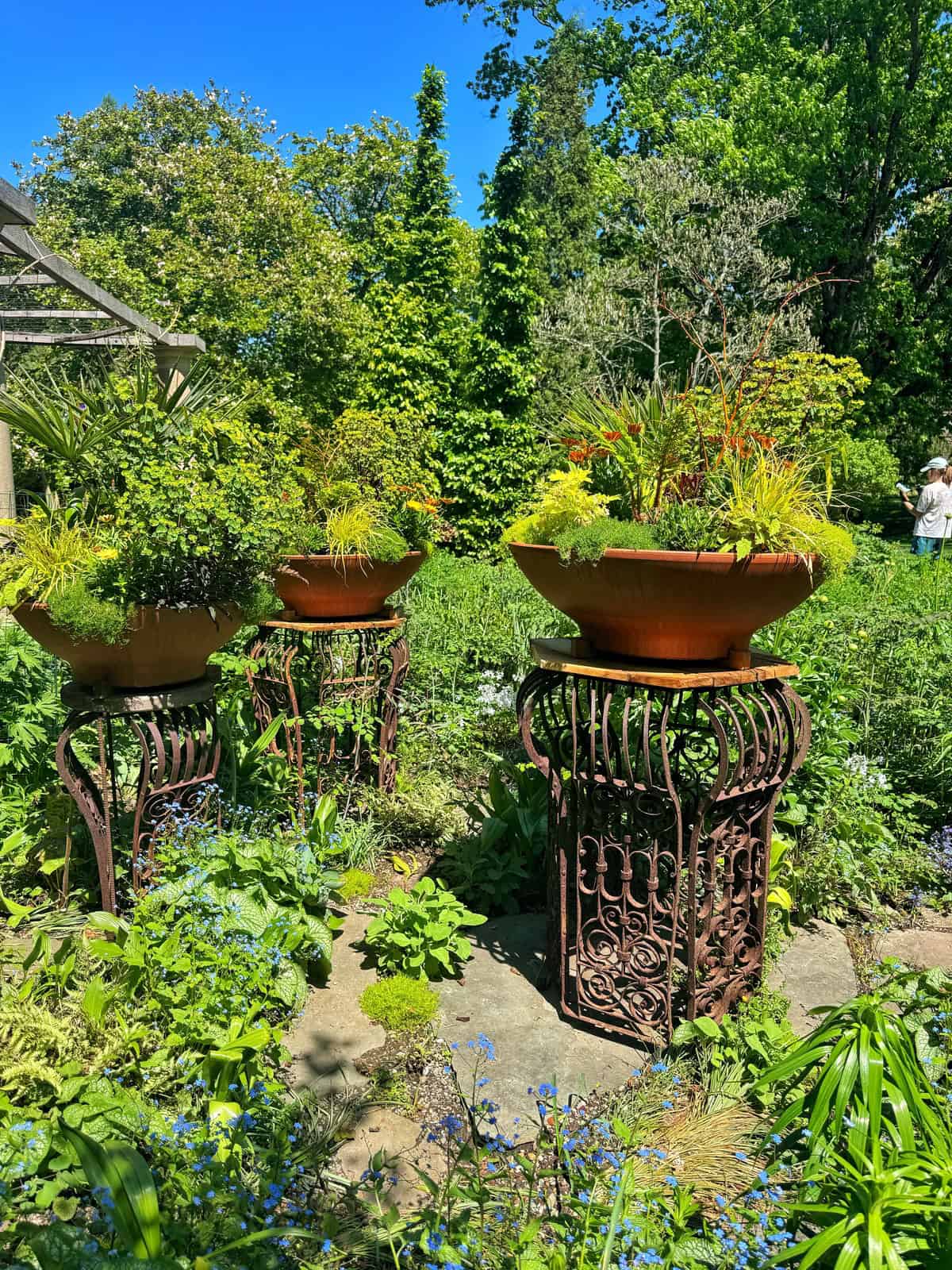
The oversized glazed teal urns used purely as sculpture. They are not even planted, simply placed in the border as architectural punctuation with a matching urn visible in the background. This is perhaps the boldest statement. Because the color of that glaze against the surrounding green planting is quietly extraordinary.
What all of these examples share is the willingness to use whatever is interesting, beautiful, or unexpected without worrying too much about whether it’s conventional. Branches as design elements. Vegetables as ornamentals. Salvage as pedestals. The garden constantly asks “why not?” and the answer is almost always “no reason.”
Try it at home: Next time you’re planting a container, consider mixing something edible in like lettuces, kale, herbs that are not for the harvest but for the texture and color. And don’t overlook sculptural containers used empty. A beautiful urn or vessel that simply sits in a border and says “something important is happening here” is worth more than a mediocre planting.
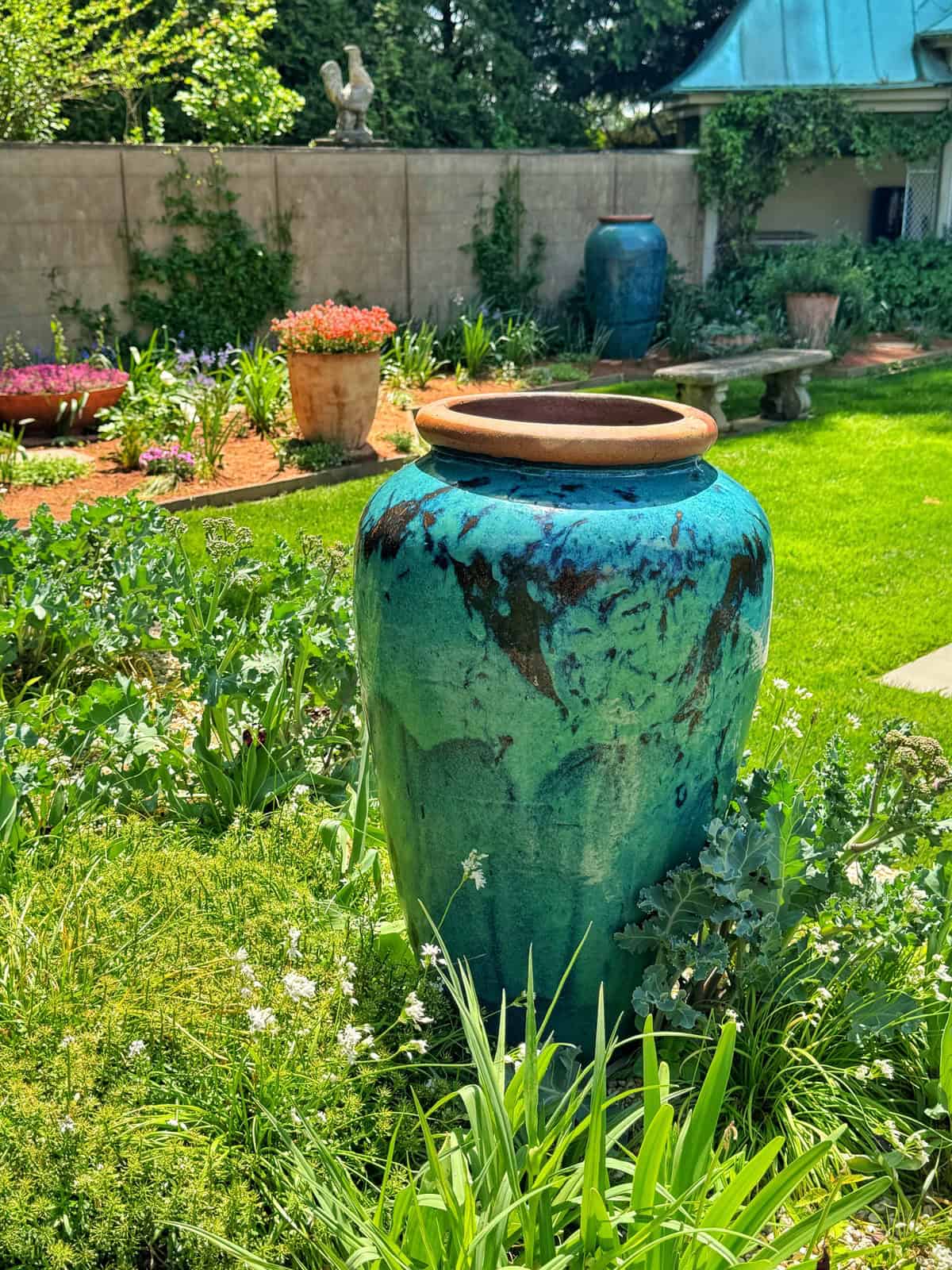
7. Letting the Garden Feel Relaxed Instead of Perfect
This might be the design secret that feels most radical to home gardeners who have been conditioned to equate a good garden with a tidy one. Chanticleer is not tidy. It is impeccably cared for, but it is decidedly not tidy.
Plants are allowed to flop into pathways. Seed heads are left standing rather than cut back. Flowers drift through borders in patterns that look self-seeded, because in many cases they are. The meadow planting with alliums and cow parsley and native columbines and red poppies and camassia all growing through each other in a completely naturalistic way, looks like it arrived on the wind. The loose, billowing quality of the planting in nearly every area of the garden gives it a sense of ease and welcome that more manicured spaces simply cannot achieve.
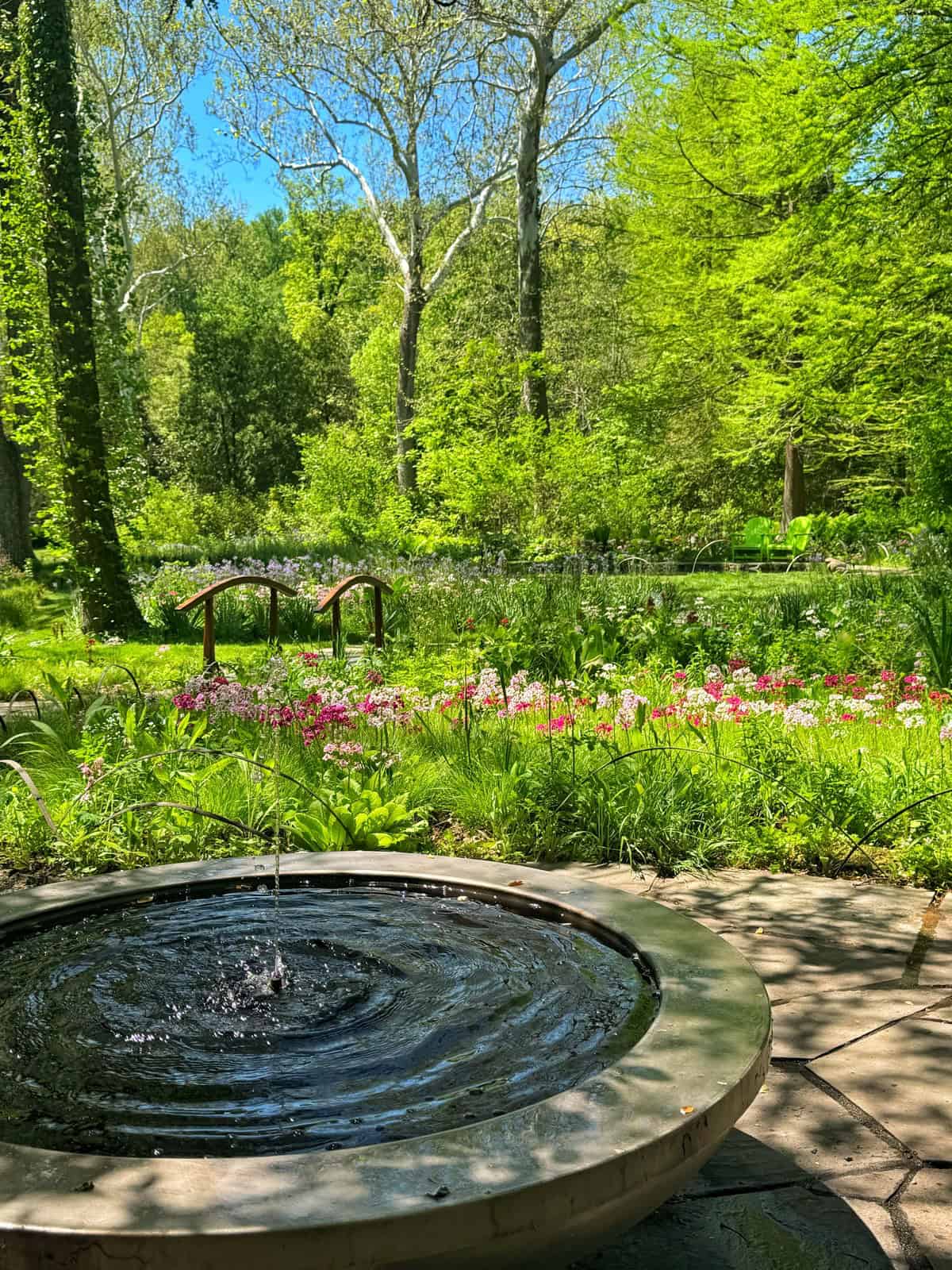
I noticed that the looseness is strategic, not accidental. The plants chosen tend to be ones that perform well when allowed to naturalize. Like alliums that spread and multiply, foxgloves that self-seed in the right spots, cow parsley that fills gaps beautifully without becoming a problem. The skill is in choosing the right plants for relaxed planting and then genuinely letting go. Which is harder than it sounds for a trained gardener.
The reward is a garden that feels emotionally connected to nature rather than in opposition to it. A garden that looks like it was made by someone who loves plants, not someone who is trying to control them. And I think that’s increasingly what garden visitors, and gardeners themselves, are craving right now.
Try it at home: Choose three plants in your garden that you normally cut back aggressively and give yourself permission to leave them this season. Seed heads, self-seeding annuals, slightly floppy perennials, then see what happens when you step back. You may be surprised by what arrives.
8. Using Color in a Softer, More Atmospheric Way
The color palette at Chanticleer is one of its most distinctive qualities, and it’s worth spending some time on because it runs counter to a lot of popular garden color advice.
Rather than creating bold dramatic blocks of single colors, Chanticleer uses color in a much softer and more atmospheric way. Colors repeat gently across the garden rather than appearing in concentrated masses.
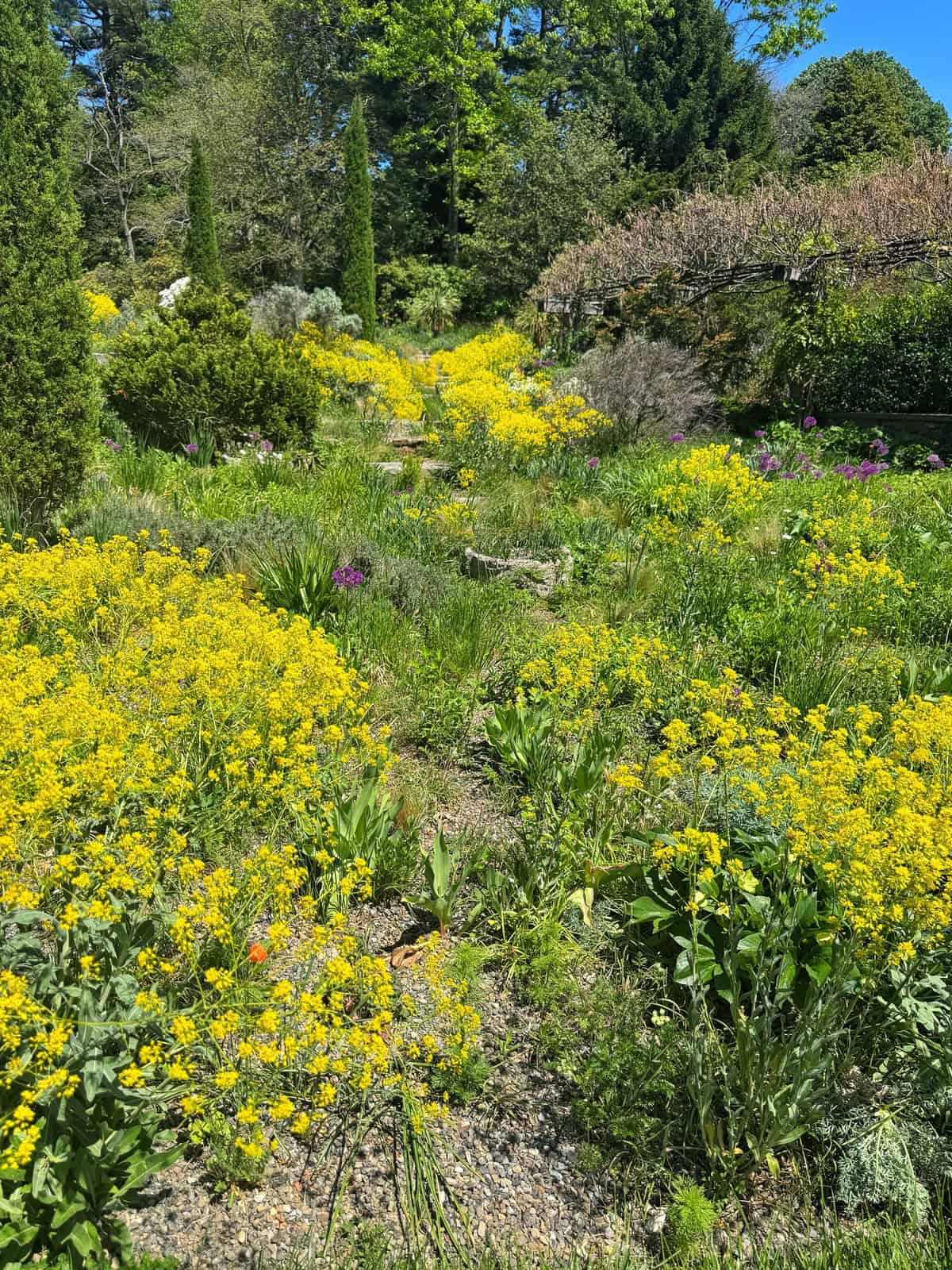
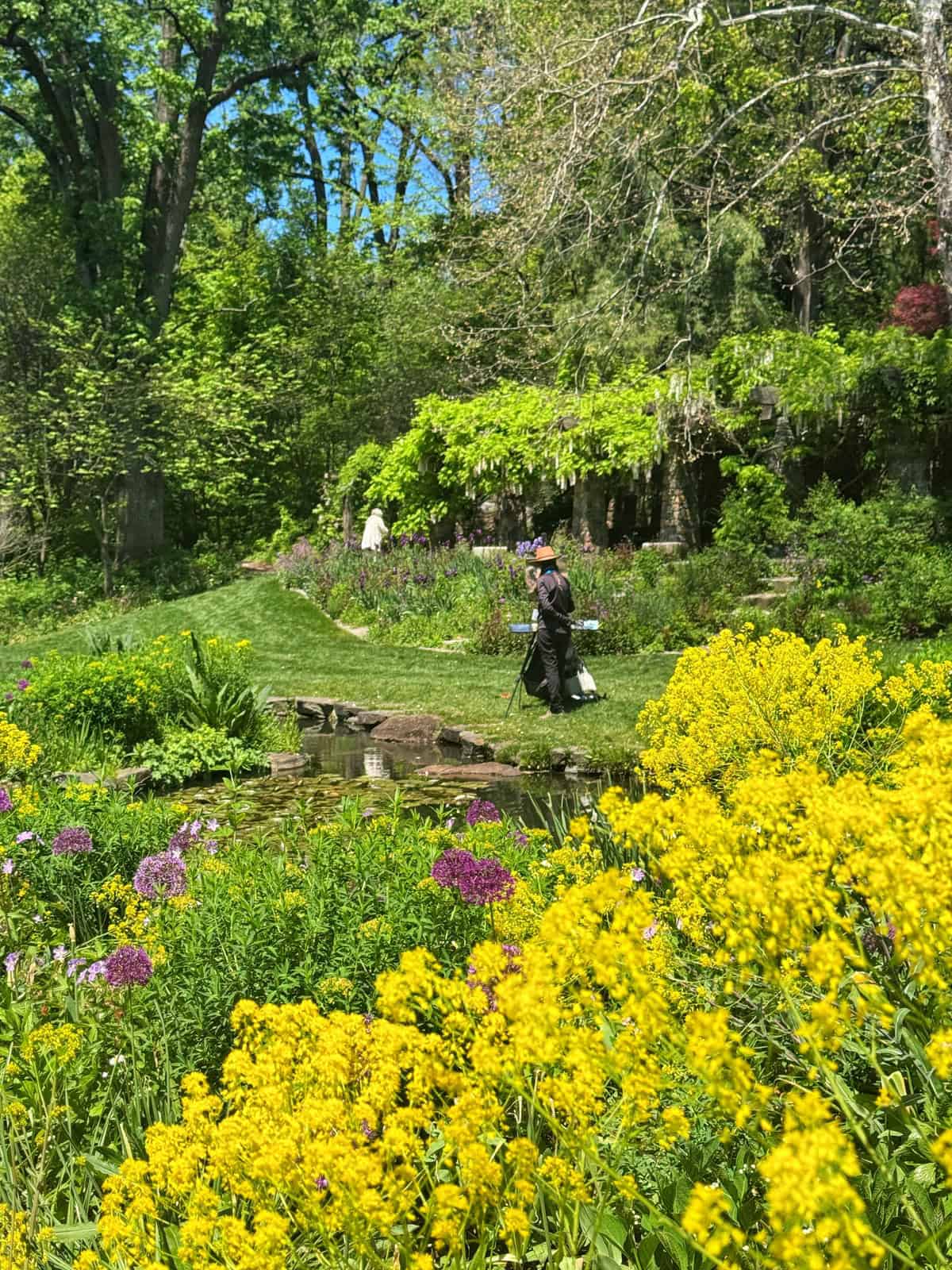
The acid yellow of euphorbia appears in multiple areas: in the meadow, on the hillside near the ruin, edging the pond borders, creating a visual thread that ties disparate areas of the garden together without ever feeling forced. Purple moves through the space in the form of alliums of slightly different sizes, bearded iris, columbine, camassia, and wisteria. It’s never the same plant twice but always the same conversation.
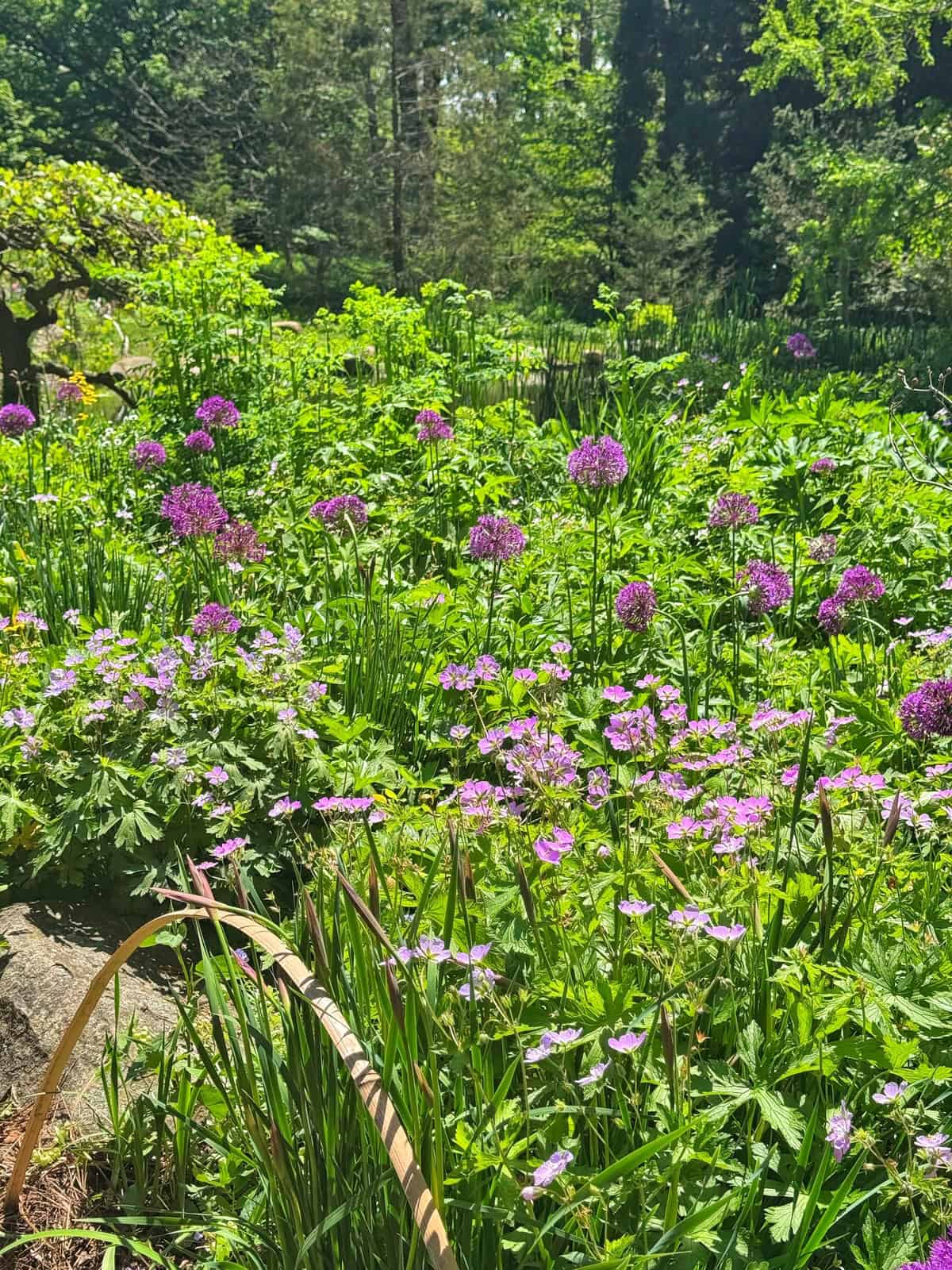
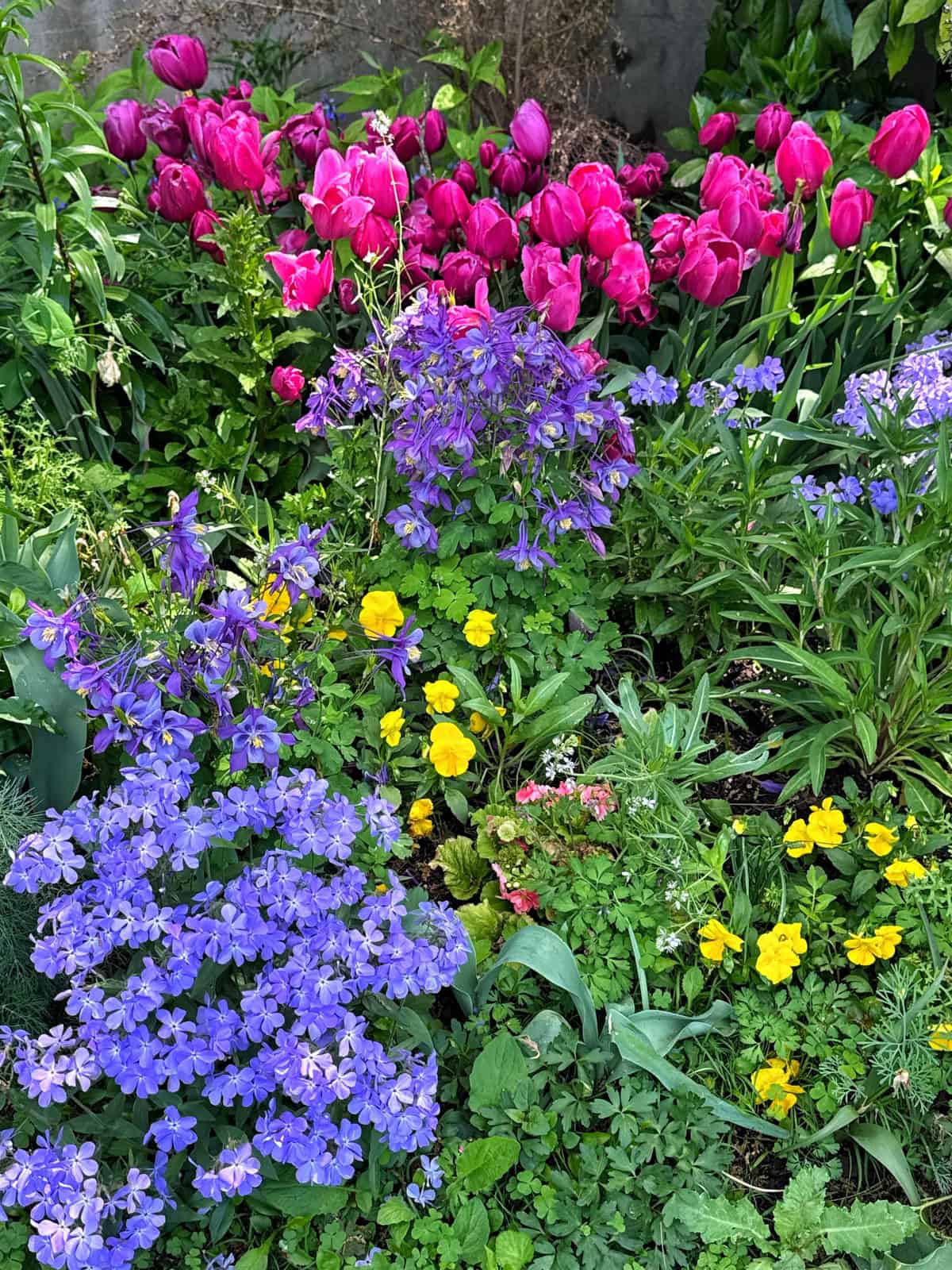
In one of the most beautiful combinations I photographed, deep magenta and purple tulips rise above a carpet of blue phlox divaricata, purple columbine, yellow pansies, and forget-me-nots. All of it weaving together in a combination that should be chaotic but reads instead as painterly and soft, because the colors are related enough in value and saturation to feel harmonious even at their most complex.
The lesson here is that color impact doesn’t require drama. It requires repetition, restraint, and attention to the relationship between colors rather than just the colors themselves. A garden where acid yellow appears in five different forms across multiple areas will feel more cohesive and intentional than a garden with a single bright red accent that appears nowhere else.
Try it at home: Choose two colors…not varieties, colors, and build your planting around seeing those colors repeated throughout the space in different plants, different forms, and different intensities. The coherence this creates is striking even in a small garden.
9. Treating Containers Like Architecture, Not Accessories
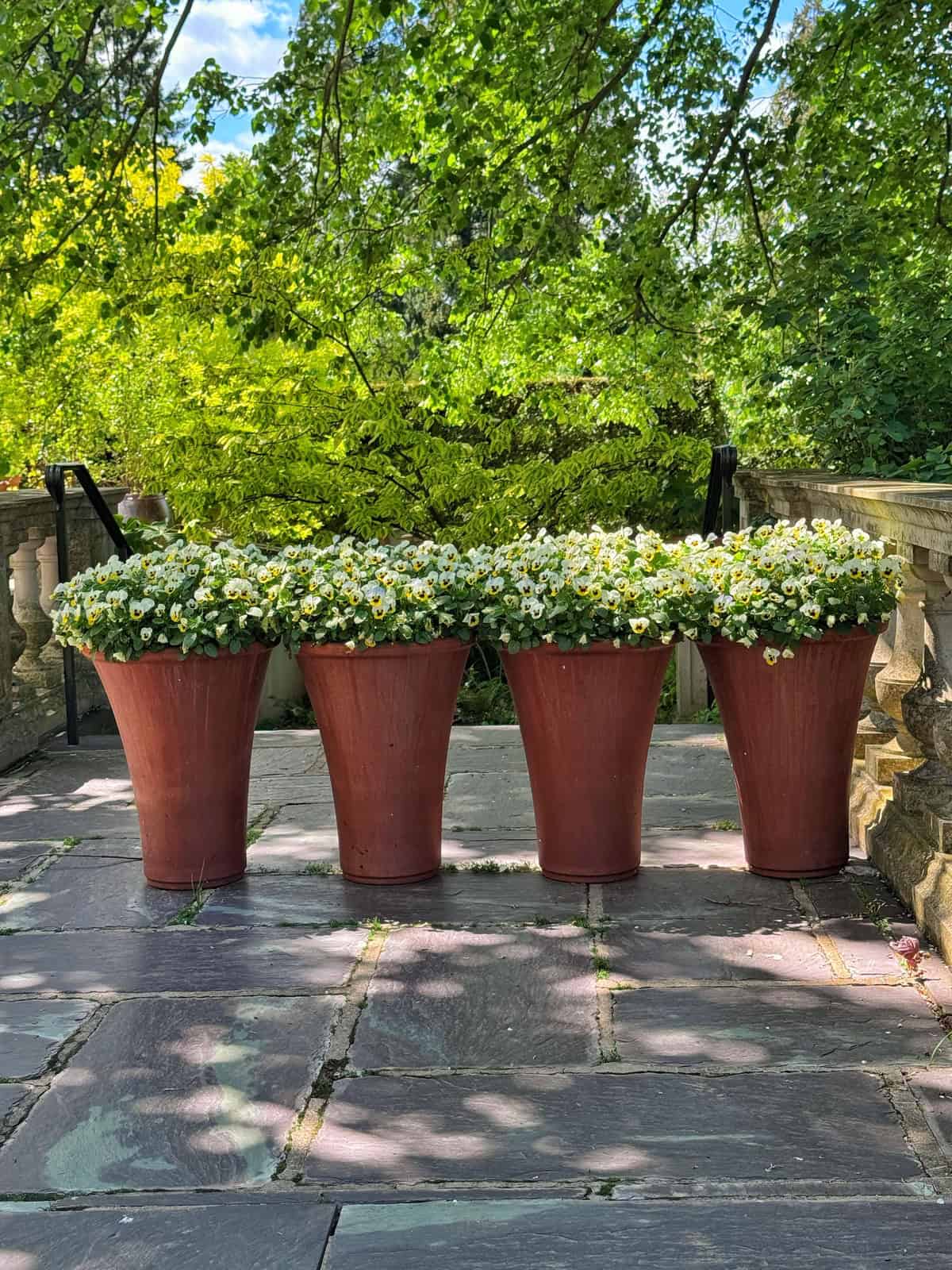
Container gardening is enormously popular, but most home gardens use containers as decoration that is something pretty to fill a corner or line a steps. Chanticleer uses containers completely differently: as architectural elements that anchor spaces, create rhythm, and define the structure of the garden itself.
The examples are everywhere. The large round burgundy vessel that anchors a corner of the kitchen garden area doesn’t just sit there. Instead, it terminates a sight line, marks a transition, and provides a focal point that organizes the planting around it.
The pair of rusted iron pedestal urns flanking a stone path don’t decorate the path. They frame it, creating a threshold that makes passing through feel deliberate. The teal glazed urns placed simply in the border without even being planted stop you in your tracks with their scale and color before you’ve registered anything else around them.
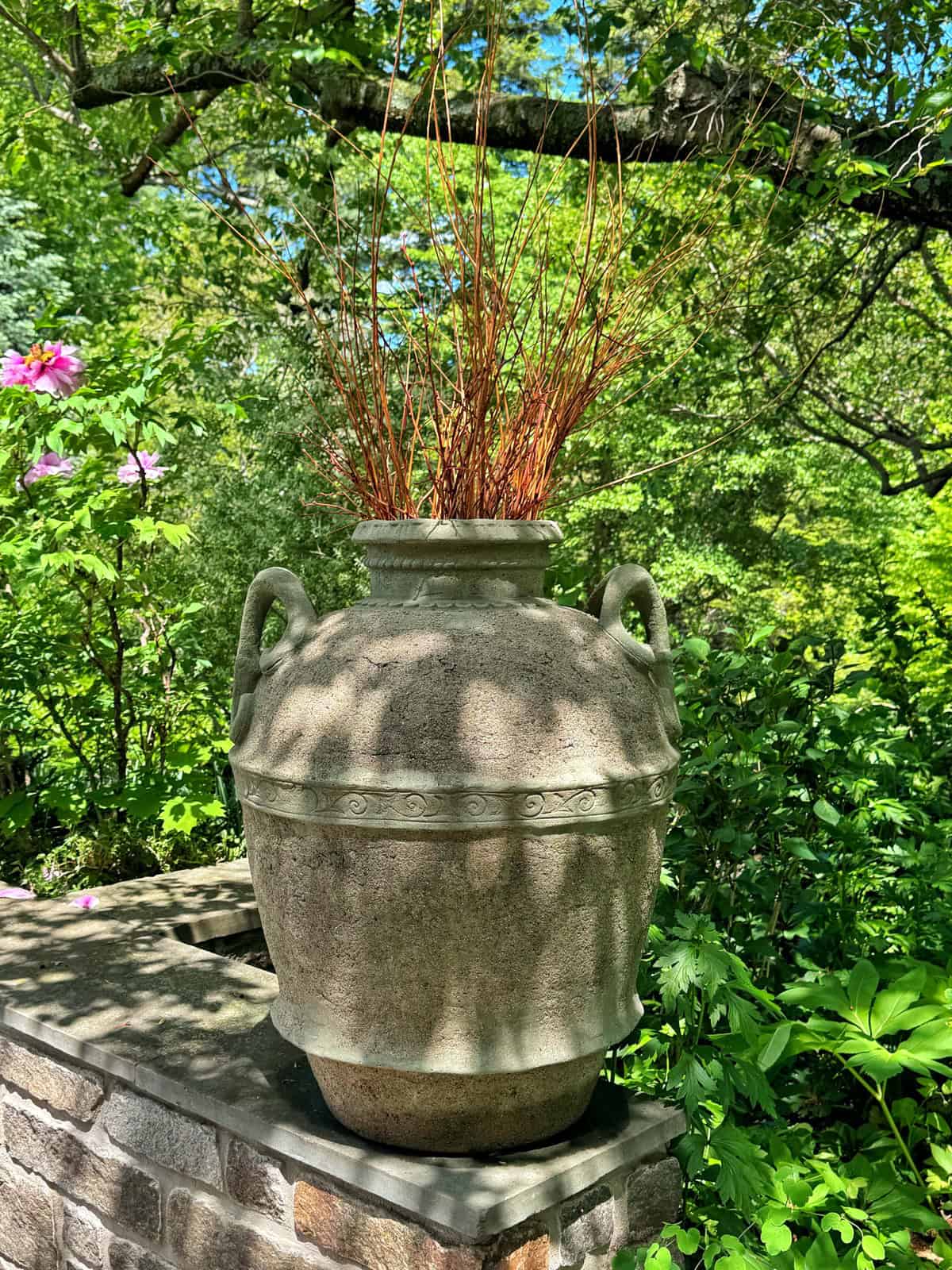
Even the simplest containers are placed with intention. The weathered terracotta pot on its plinth marks the corner of a border. The stone amphora-style urn on the wall is planted with nothing but dramatic upright red-stemmed branches, possibly Cornus alba, that create a vertical exclamation point against the surrounding green canopy. The container is the architecture. The planting inside it, or the branches erupting from it, are secondary.
For home gardeners, the practical takeaway is to think less about what you’re putting in your containers and more about where you’re putting them and what role they play in the larger garden structure. A beautiful container in the wrong spot is invisible. A well-placed container, even planted simply, can transform how an entire area of your garden reads.
Try it at home: Walk your garden and identify the sight lines and note the views that draw your eye naturally from one area to another. Are there containers placed to anchor or terminate those lines? If not, that’s your starting point. Scale matters here: when in doubt, go bigger than you think you need.
10. Designing for Discovery — The Secret That Ties Everything Together
I’ve saved this for last because I think it’s the heart of what makes Chanticleer so emotionally affecting and so different from most public gardens, and from most home gardens too.
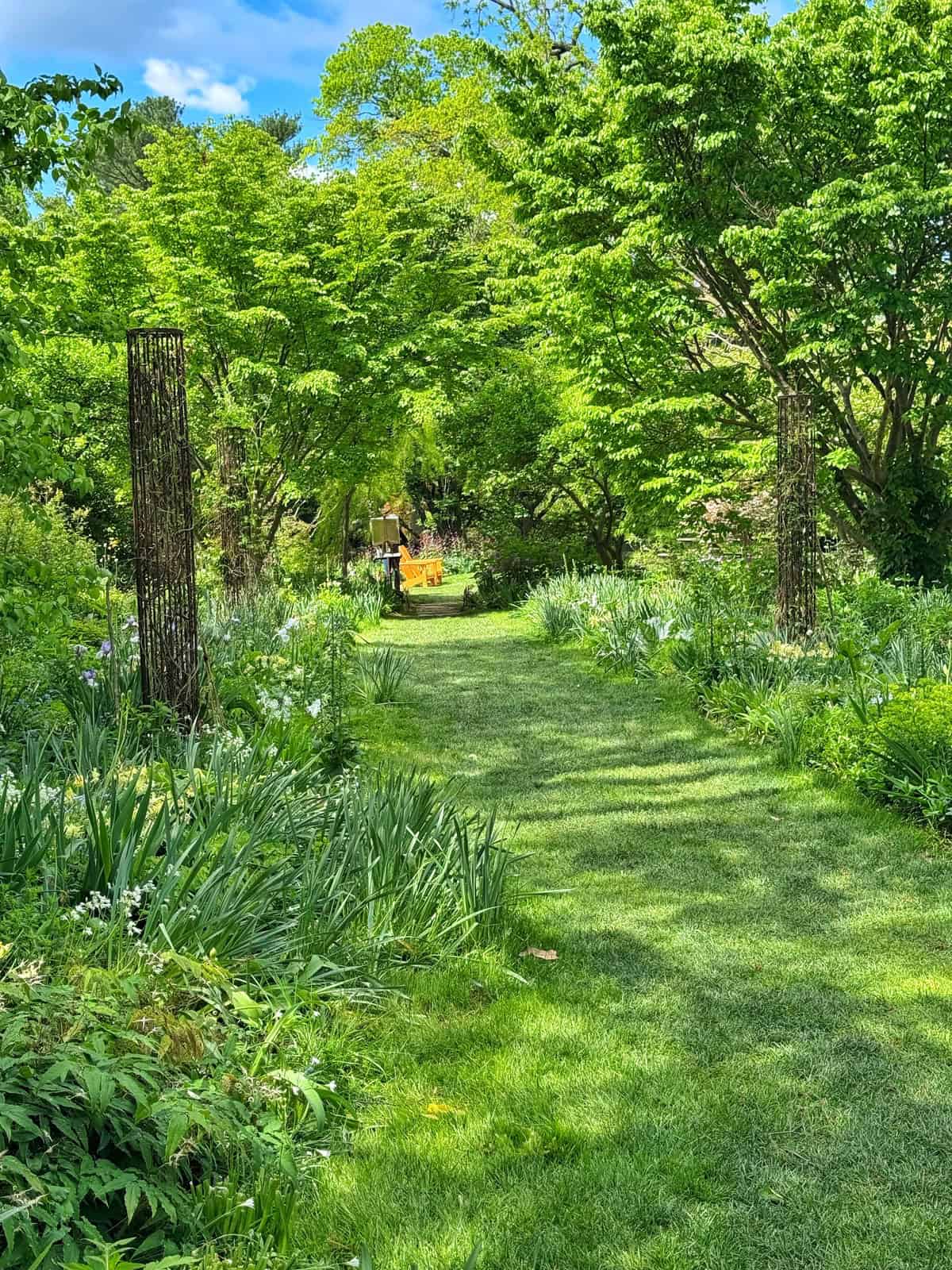
You never see all of Chanticleer at once. At every moment, there is something just beyond what you can currently see: another path disappearing around a corner, another framed view through a gate, another bridge crossing to another area, another arch pulling you forward. The garden is in a constant state of revealing itself, and that process of revelation is itself the design.
When you enter through that iron gate and look up at the rose arch with the garden spreading beyond it, you can see three separate layers of discovery: the arch itself, the meadow planting beyond it, and the red Japanese bridge in the middle distance leading somewhere else entirely. You’re not looking at a garden. You’re being invited into a journey.
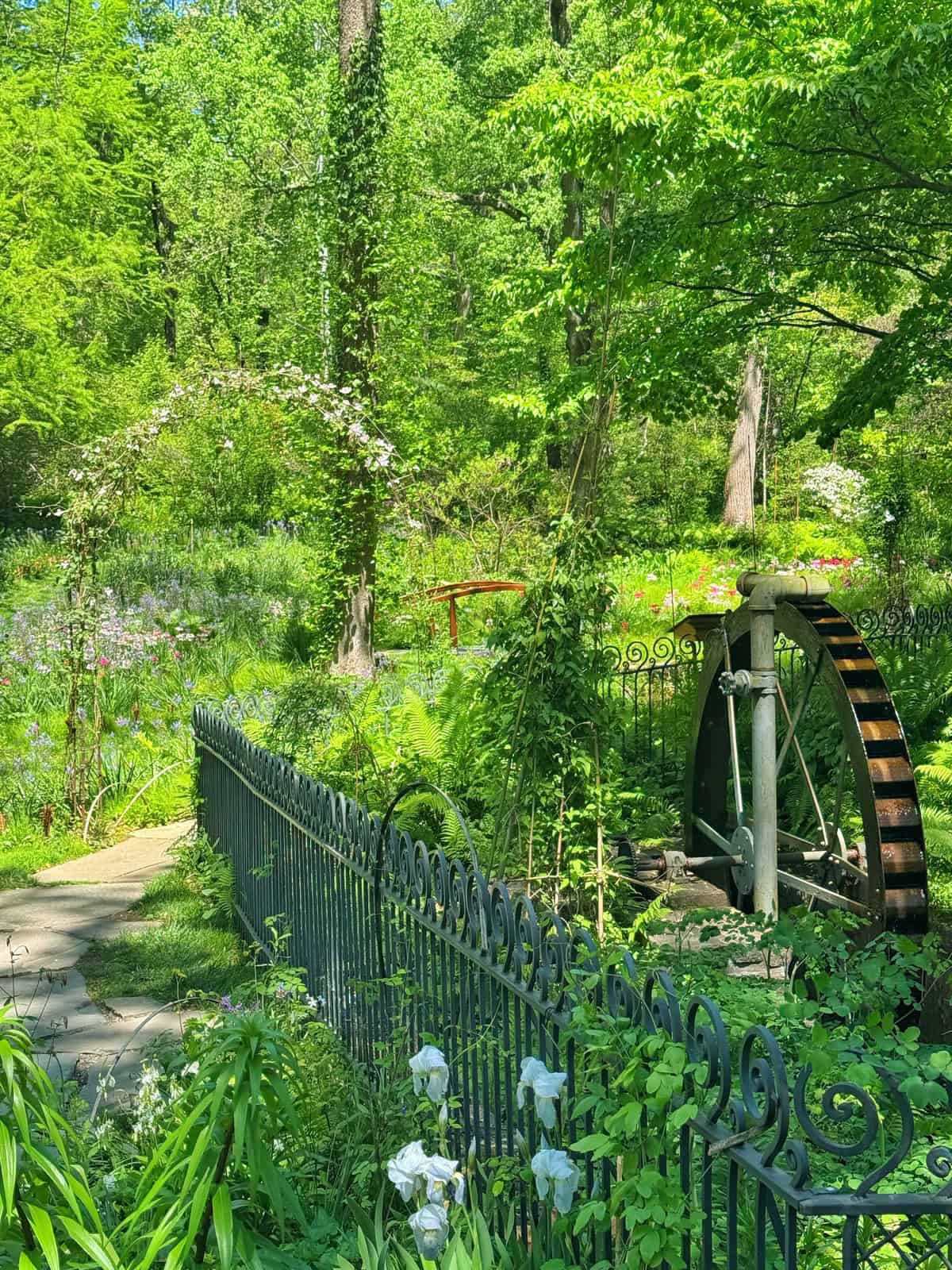
The woodland path that disappears into bamboo and shade planting is perhaps the purest expression of this principle. You cannot see where it goes. The path curves gently out of sight, the plants close in around it, and the only way to find out what’s there is to walk forward. That invitation to curiosity, the willingness to be surprised, is what makes some gardens unforgettable and others merely pleasant.
A home garden can create this feeling at almost any scale. It requires only the willingness to not show everything at once, but rather to let something remain just out of view, to create a reason to keep moving, to design not just spaces but transitions between them.
Try it at home: Stand at the main entry point of your garden and ask: is there anything I cannot see from here? If the answer is no, your garden may be missing its most powerful emotional tool. Even a simple curve in a path, a screen of tall perennials, or a destination seating area that isn’t visible from the house can transform a garden from something you look at into something you experience.
What Chanticleer Taught Me About My Own Garden
Leaving Chanticleer, I didn’t feel overwhelmed. I felt inspired in the best possible way. And that kind of inspired sends you straight home to the garden with ideas you actually want to try.
The looseness. The foliage thinking. The way the stone ruin and the planting have become genuinely inseparable. The containers used as architecture. The colors that float through the space gently and persistently. The paths that don’t show you everything at once.
None of these ideas require a team of horticulturists or an estate-scale garden. They require attention, intention, and a willingness to let go of some of the control that we as gardeners tend to hold too tightly. They require thinking about how the garden feels, not just how it looks. And they require trusting that a garden allowed to breathe and move and self-seed and weave together is more beautiful, not less, than one kept perfectly in its place.
That’s the low-maintenance design philosophy I’ve been working toward in my own Zone 6b garden for thirty years. Chanticleer showed me what it looks like when that philosophy is fully realized. And I left with a notebook full of ideas and a renewed love for the whole beautiful, imperfect, endlessly surprising process of making a garden.
Want to Take These Ideas Further in Your Own Garden?
If you walked away from this post thinking “I love this, but I genuinely don’t know how to translate it into my own space” — that’s exactly the feeling I wrote The Bricks ‘n Blooms Guide to a Beautiful and Easy-Care Flower Garden to solve. It has ready-made garden plans built around this kind of layered, intentional design thinking so you don’t have to figure it out from scratch. Grab your copy here →
And if you’re the gardener who visited Chanticleer, came home full of ideas, and knows you’ll forget half of them by next season — that’s what the Bricks ‘n Blooms Beautiful and Easy-Care Flower Garden Planner is built for. It’s the system that lets you capture what inspired you, track what you try, and actually build on it year after year instead of starting over every spring. Find it here →
Final Thoughts on Chanticleer Garden
What I loved most about Chanticleer is that it felt incredibly artistic without feeling intimidating. Creative, relaxed, and personal — like a garden designed by people who genuinely love plants and pay close attention to how spaces feel emotionally.
The ideas themselves are approachable. The plants, for the most part, are ones any serious home gardener would recognize. The structures are beautiful but not palatial. What elevates Chanticleer beyond beautiful to truly unforgettable is the thinking behind every decision. Because there is intention, the attention to how things feel, the willingness to experiment, and above all the commitment to designing a garden that invites you to keep exploring.
You leave inspired instead of overwhelmed. And for me, after thirty years of gardening and studying gardens, that is the highest compliment a garden can earn.
Have you visited Chanticleer? I’d love to know what stayed with you longest. Drop it in the comments below so we can chat more.
Thank you for visiting the blog today!
Enjoy your day! xo

Originally Published .
